PANIC OF EARTHQUAKE DEVASTATION IN LAHORE 1904
THE FAMOUS EARTHQUAKE OF QUETTA ALSO HIT LAHORE
Fading memories of phenomenal loss in city 4th April
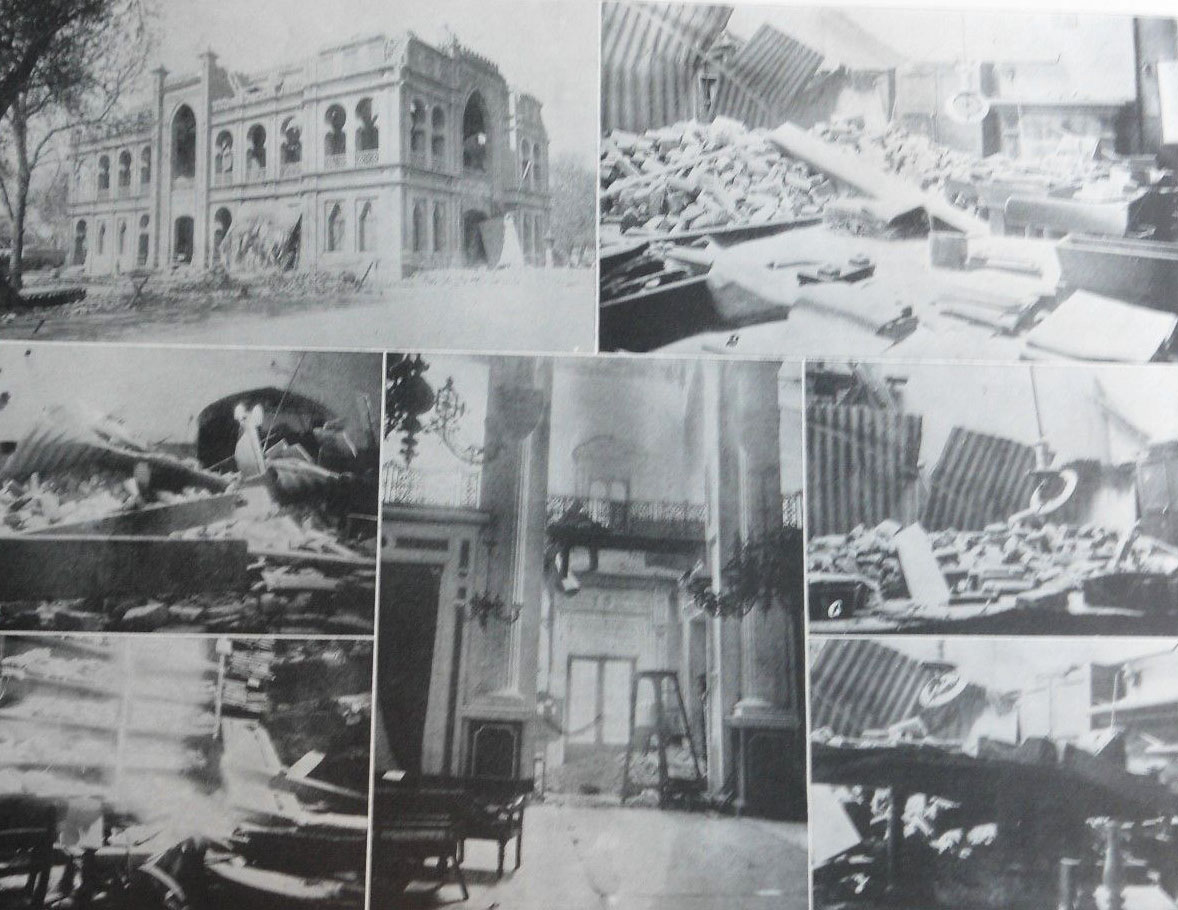
Earthquake in Lahore 1904
A magazine in London carried the news of the Earthquake in Lahore on 4th April. The magazine is dated 1905, the earthquake could have been in 1904. Maybe 1905 is also possible. We have no access to detailed record. Suffice that the event was important enough to be a news item in England of that time. That besides photographs of the devastation, even paintings were made with the Wazeer Khan Mosque in the background. Keeping the history of Lahore alive is one thing. Imagining the terror of those days is another. Lahore has certainly been a witness to the strangest things possible.
Devastation in Lahore 1904
The sad part is that to this day here is no Rapid Response Team in Pakistan to such catastrophes. They happen all the time, the Army comes in, the Civilians talk loud, go for photo sessions but COMPASSION none for victims. Only people care for people. The Government sits idle in the true way of NERO FIDDLING WHILE ROME BURNT.
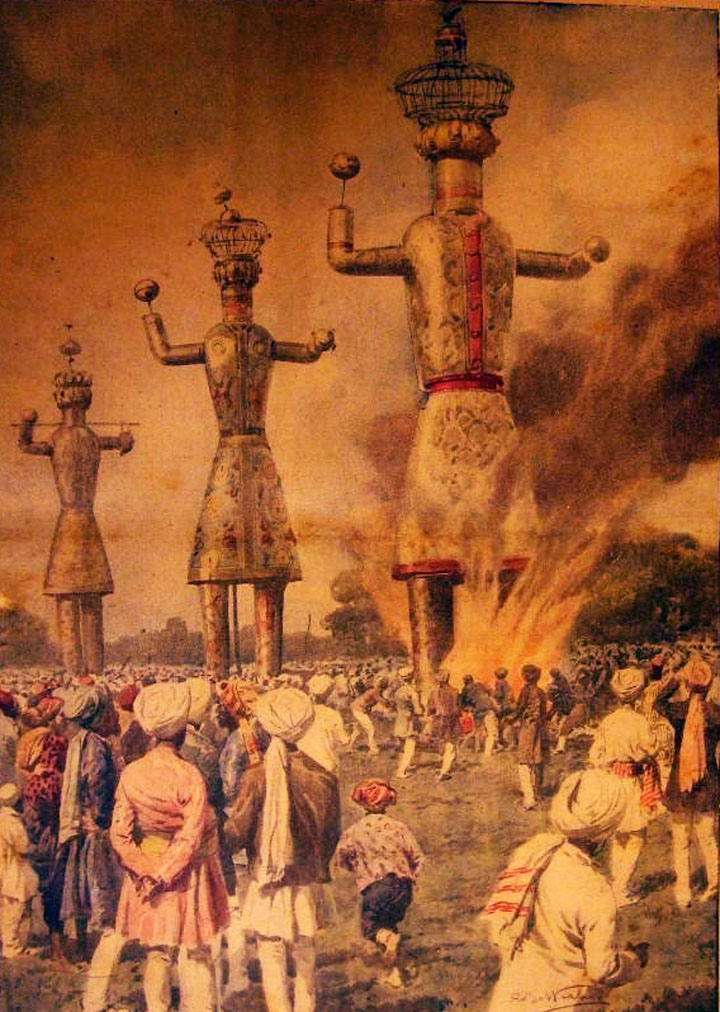
A RAVAN FESTIVAL IN LAHORE 1923
SUNDAY COURIER LAHORE REPORTS FESTIVAL
Not even in peoples memory today
Ravan festival Lahore1923
The area in front of Lahore Fort has witnessed many things. The Minar of Pakistan stands there today, but in the same vicinity there used to be many things. Known to us as Minto Park, it housed an annual exhibition of things. Ladies of Lahore thronged there not only to see things but buy things of their choice. Regular Kite flying (Patangs) were there on holidays and the standard was the peak of Lahore. Fondness for research is there now and a student from NCA, Ms Zoya Hassan is researching a thesis on Guddi ground.
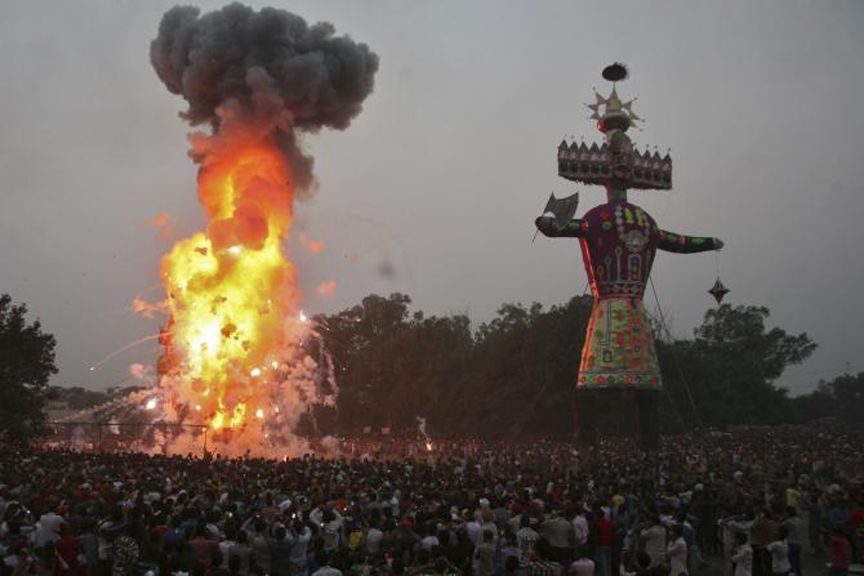
Present Ravan festival
We came across a reference in newspaper magazine of France, namely Sunday Courier in 1923, with a drawing of a RAVAN FESTIVAL in Minto Park Lahore. We are told by the paper that there were 200,000 spectators to see the event. Obviously not all would be Hindus as the drawing itself shows Muslims enjoying the show too. Strangely we do not see anything like that today, but it is a thing that is there all over India, to this day, as can be seen by various images. So enjoy a page from the past!
Same still today
Strangely on one side, outside Taxalli Gate Lahore was the HINDU WOMEN BURNING GROUND, where they cremated their dead Hindu ladies. People recall the smell of burning flesh in the area. On the other side was the place where Zorastarians or our Parsee brethern left their dead bodies behind for the traditional end of being eaten by birds and animals and the throwing of the remains in a traditional well, the Silent Tower of Lahore. The symbolic killing of Raven no one remembers at all.
WALL PAINTING IN LAHORE AS TRADITION, YES
LAHORE BOASTED PICTURES AND SCULPTURE ON ROOFTOPS
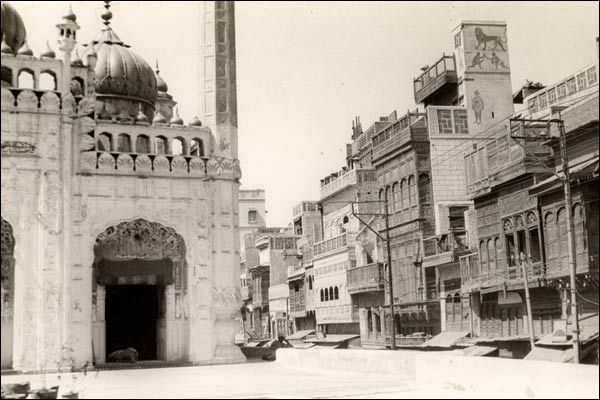
Lahore 1935
INFLUX OF RURAL MIGRANTS DESTROYED LAHORE’S LEGACY
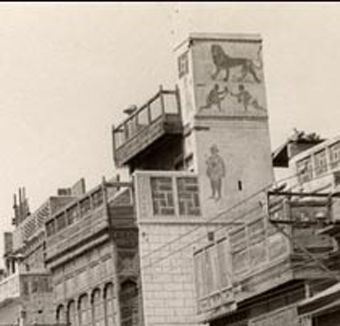
Lions and Wrestlers
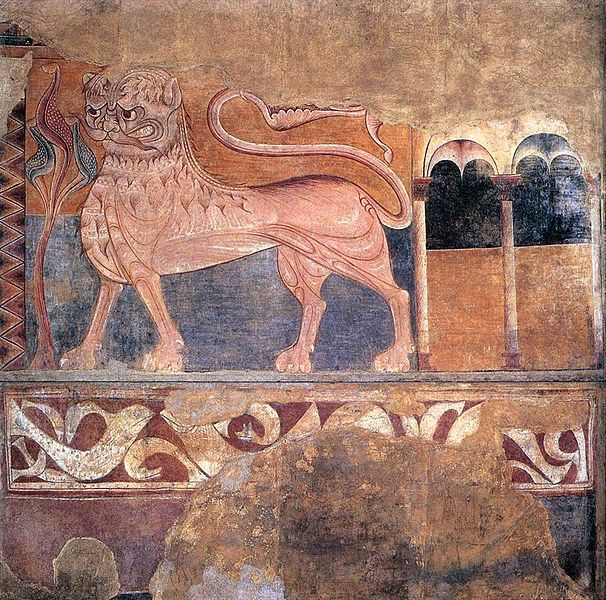
The pictorial fancy was very much a part of the legacy of Lahore. I remember we used to admire Lions in bricks and choona on the roof tops of Lahore. This was a legacy of old times. Similarly pictures of Lions as well as other subjects adorned the walls of Lahore’s houses but there is little visual evidence left. Why? For nobody bothered to take care of that legacy. Obviously artists were there and they were either masons or attached to masons, as these kind of pictures required scaffolding on high walls of Lahore’s houses. Strangely this tradition goes back to centuries as we trace its origin to Turkey as well as Byzantine Empire.
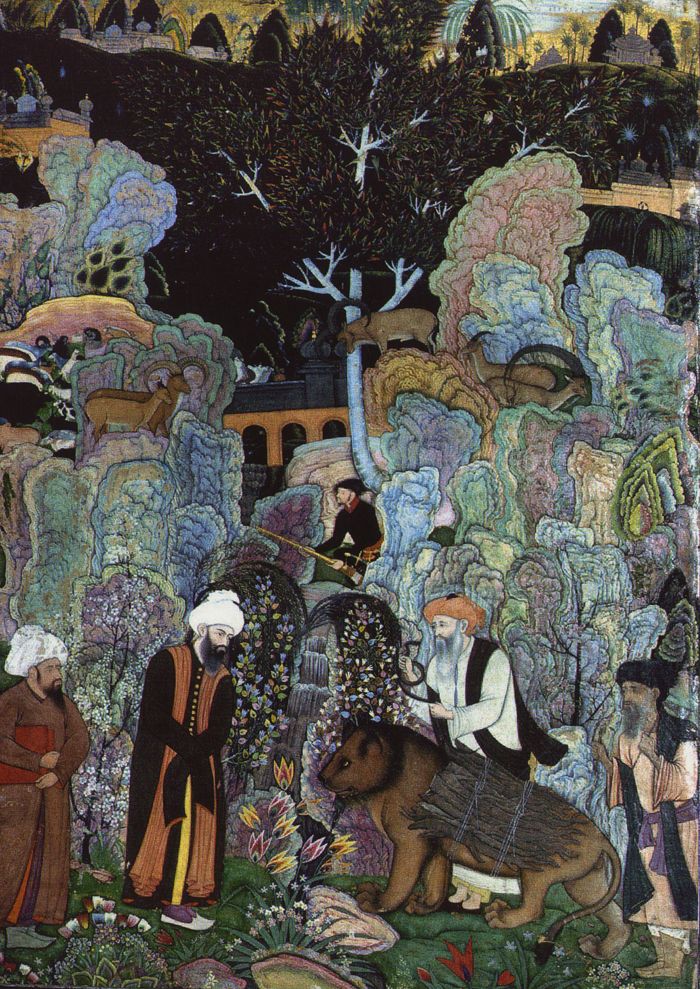
Taming a lion
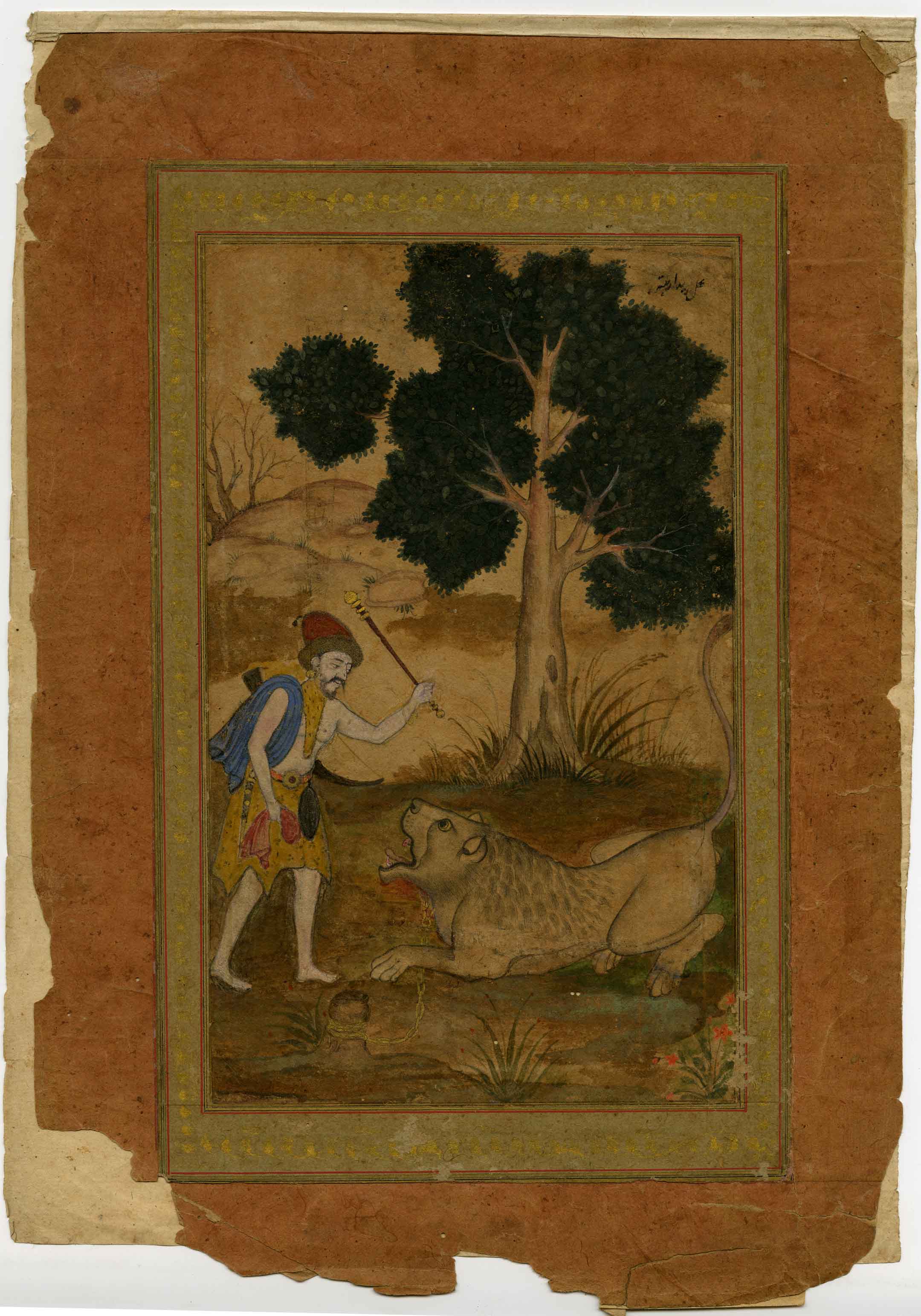
In a city where lions were used in the Lahore Fort as watch dogs, what could be expected? Heroes were supposed to be lion hearted at all times. Even helmets had lions on them. It is no surprise that in diggings, bones of lions come up all the time. The historian Baiqui talks of lions roaming freely in the Jungle of what is now Sheikhupura or Shahdara. Incense burners with lion shapes all the time. Nowadays the legacy can be seen on truck walls in a similar way. Fine Arts became Folk Arts with time.
12th century lion like Lahore wall paintingLion Tamer
EVEN BLEAK TIMES IN LAHORE 1796 AD, YET PAINTERS THERE
SHAHBAZ BILGRAMI LAHORI MAKING ON DEMAND PORTRAITS
A rare portrait of Sardar Ilm Khan Wazir of Taimur Durrani
Ilm Khan Timuri by Shahbaz Bilgrami Lahori
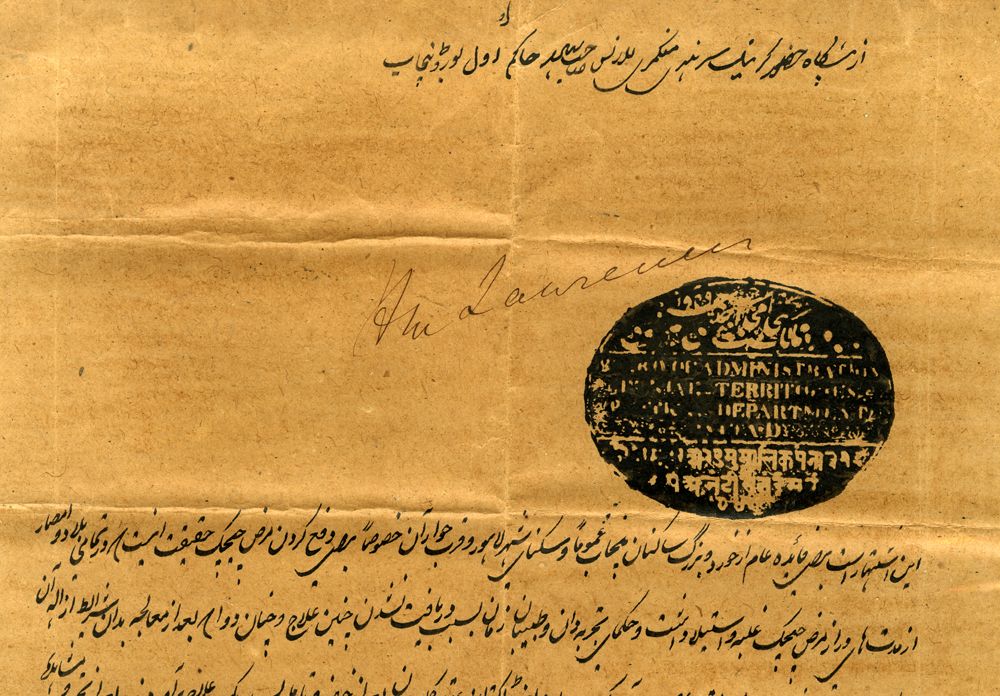
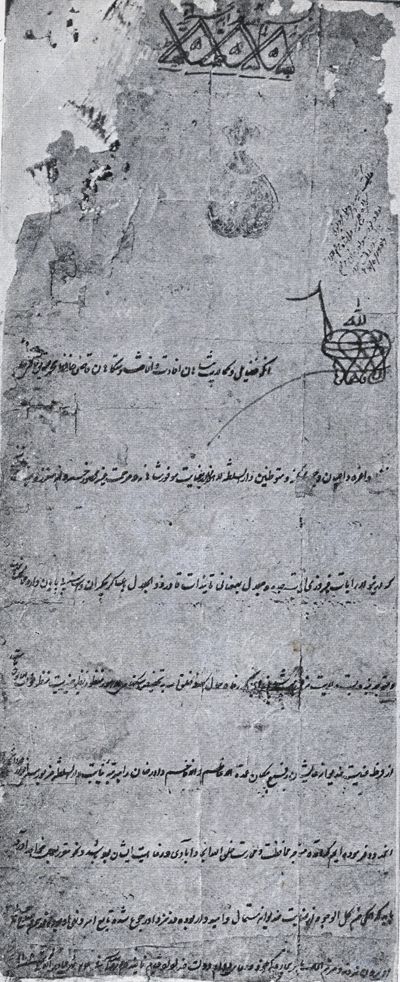
We do not know the present location of this work, but it is a rarest kind of work. This is before Ranjit Singh captured Lahore. It is signed as Amal Shahbaz Bilgrami and it is a portrait of a Wazeer of Viceroy of Lahore Taimur Khan Durrani, descendant of Ahmad Shah Abdalli. Of course it is a reflection of those times that the portrait is plain as well as the illumination. But in those bleak times, the presence of painters in Lahore makes some sense of our assertion of Lahore being obsessed with its pictorial legacy. Even the farman of that period addressed to Qazi Muhammed Siddique of Lahore represents the bleak times in the city.
Farman Ahmad Shah Abdalli
There were great artists even in those times. Two brothers who used to live in the Chowk of Nawab Wazeer Khan, namely Elia (Ali) Naqash and Nabia (Nabi) Baksh, for lack of patronage, decided to migrate to Jammu and Kashmeer. We have in our archives some paintings on Hindu themes by Elia Naqash, but that is a different story.
The Origin of Lahore is a myth. The more we try to uncover the past, the more puzzling it really becomes. Of course people write, but people write with mere spurious references. No one goes to the origin of the truth. In this race for uncovering the past, one comes across strange figurines, which normally are in no ones record. Preconceived debunking old Muslim Civilization is always there, for no one believes in the sophistication of past Muslim dynasties. The truth becomes self evident with proof from the past.
Lahori face 2Lahori face 2 b
A trove of research material is with us but except for us ourselves, no foreign scholars to the scene to dig up our past. To prove that Sultan Mahmud Ghaznavi’s Court life was full of splendour, would be against the hype about his alleged ruthlessness. One of the greatest Universities of the World was in Ghazni and people from all over the world came to research on its library. One of the most magnificent mosques in the World was in Ghazni, and so big, that it was meant to house the entire population of Ghazni in it. Reduced in height stands two of its minarets to remind us of the vision of the Sultan. The greatest research and poetry was written in those times. Sultan Muhammed Ghori’s tower as well as Qutbuddin Aibak’s tower n Delhi tells us of the aesthetic choices of those dynasties. In this way a study of Lahori figurines lead us directly into the past splendour.
Lahori face 3Lahori face 3 b
Discovered with deposits of Ghaznavid coins, of Sultan Ibraheem’s (grandson of Sultan Mahmud) dynasty are some heads with crown in shape that look like the Jesters Hats of the Western world. Really how? It came to my mind that the Western world was fond of ridiculing its opponents, and may have developed the Ghaznavid Crown, as a Jester Hat for their Court. Who knows? In fact there is more of Seljuk and Chinese influence in it. Even Chinese faces come up in Lahore’s past, of ordinary people as well as leaders in their own rights. Our guess would be Mongolian influence, the forefathers of Mughals, and probably linked to Changez Khan as well as Timruid influence on Lahore. It may very well be the truth. For little is known about those periods of Lahore. We may know more. Till then just enjoy Prince and Princesses, Kings and Queens of the past, and damn everything else to hell! Live a life of pride in our past aesthetics.
YURI BEZMENOV TALKED OF PAST IDEOLOGICAL WARFARE AGAINST PAKISTAN
WHAT ABOUT THOSE WHO ARE DOING THE SAME THESE DAYS?
Yuri Bezmenov formerly KGB Novosti
Can we identify them, easily said than done
We know of Yuri Bezmenov who was a KGB agent of Novosti. We all know his stated methods of Ideological warfare, as he says:
Demoralization
National Identity is diluted with aspersions towards historical references.
Crisis
Break down of self control resolutions on moral behaviour.
Normalization
Lost national identity becomes accepted as the norm with the new societal values.
Disruptions
People used for ideological warfare dumped and governments become totalitarian.
Subversion
This happened in East Pakistan and for that a lot of Pakistanis were used. The result East Pakistan was destroyed and a pseudo unit created for consumption of those railing against our Two Nation theory. Dumped in the sea, said Indira Gandhi, why is it being revitalized in Bengla Desh today? When those saboteurs were dumped, they got picked up by other agencies for same work.
Media in various forms is evident with a tirade against our Identity and Ideology. The kind of bullshit written with our historical perspective is amazing. Who is allowing all that to happen? People disguised as thinkers and intellectuals, so called forward looking people, are retrogressive to the extreme. For petty advantages, they are attempting to ruin our Identity. Pick up any newspaper, talk show etc and clearly you will see people like this. Rest assured they are not independent and are doing it merely for petty gains, probably a promised bottle of alcohol, mainly, or a Visa, or something like that. A lecture tour, maybe! A degree from abroad. Possibility of publishing their bullshit version in form of a book. Perhaps a free night at a foreign brothel. Perhaps even a Monthly stipend. Crude, disgusting, that is all we can say!
Topsy scurvy it is! The very same KGB which halved our country in two at that time, is trying now under Vladimir Putin to consolidate our Pakistan. That is the real irony of it all. In international relations this happens all the time. But in our Islamic system of governance, a friend is a friend forever. Our diplomatic cadre failed. The basis of our civil service got wrong. Men of family and noble background were replaced by cut throat bandits to usurp our country. Living beyond their means they harassed the country thoroughly to this day.
Now trying to save Pakistan
Why subversion is failing? Thanks Allah! This kind of media access is reduced to a small percentage of people. The majority know what their parents told them, and that is why the FLAG OF PAKISTAN is flying sky high to this day. Education yes, polluted education is the worst of them all. It seeks to caste doubt on our historical truths. Yuri Bezmenov has taught us something. We need to listen.
MODESTY HAS BEEN PART OF OUR CULTURE IN ISLAMIC SOCIETY
OUR LADIES REQUIRED NO CHASTITY BELTS AS IN WESTERN WORLD
28-Modesty
MORAL VALUES BRING SELF CONTROL INSTEAD OF CONTRAPTIONS
Chastity belt with heavy lock
We have all heard of the tale of Henry the Eighth who wanted to get rid of his wife Ann Boleyn. He accused her of adultery and had her beheaded, much to the chagrin of the public. But more usually the Western world had no concept of leaving their women alone for a long period of time. They knew the frivolous behaviour of their wives, as well as women folk. So they invented the CHASTITY BELT, made of mostly iron, with a heavy lock on it. The key they took with themselves in their journeys far away places or even near their houses. And mind you it was not to let virgins remain virgins, it was meant to inhibit the behaviour of their consorts and they had no trust in them of any kind. The Chaucer tales tell us about the seriousness of intent of behaviour. The women were considered libidinous and never in control of themselves.
Medically endorsed
Virginity in our Culture is a sense of pride and without hesitation, it can be said it is there in Pakistan, as nowhere in the world,. Interesting western education has brought leniency in this view. Our own culture stands tall in this respect. In the Western world virginity in the past or today is considered with a sense of shame. A Virgin in Western world is an outcast of society. That is why that society has become Islamophobic for they know the values do not intermix. Virtue is a pride for us.
Antique Russian chastity beltFigurine with chastity belt 1700
In 1932 on a visit to London, a Muslim visitor from Lahore, was looking here and there in Trafalgar square. The Bobby asked him, what he was looking for? The Lahori said, I am looking forward on seeing a virgin here. The Bobby started laughing and said look at the Nelson Statue. When it moves, you will know that a virgin is passing the place. If that was then, what about now? The Laws of Allah does not abstain us from any intimacy, it just regulates same in a responsible way. And that is ingrained in our culture and no ideological bashing can take it away from us. A stroll in society can tell us how seriously this issue is taken by all.,
BADSHAHI MOSQUE WITH CUPOLAS ON MINARETS
A RAREST VIEW OF THE MOSQUE IN 1725 AD
Badshahi Mosque 1839 William Barr
MISSING CUPOLAS NOT RAVAGES OF THE TIME
We all know that the Badshahi Mosque was in very bad condition in Sikh times, as it was used as an artillery as well as a stable by them. It was also used as a residence by one of the Generals of Ranjit Singh. Most images of the past show a view of the Badshahi Mosque with minarets minus the cupolas on them. Most writers have repeated the assertion that the cupolas were destroyed by an earthquake in 1840 and subsequently removed. However engravings of 1838 as well as 1839 show that the Cupolas were even missing at that time. This earthquake conjecture seems to be all wrong.
GetAttachment
Sher Singh as well as Hira Singh used the top of the minarets to mount cannons on them to fire at the Lahore Fort but that was in and after 1841. What is the actual background of the missing cupolas?
Lahore 1725 full
Ahmad Shah Abdalli left Lahore in 1763, appointing Kabuli Mal as Governor of Lahore. G. Forster who visited Punjab in around 1783, records in his travelogue:
Badshahi Mosque by Fanny Eden 1838
” The Siques….. they beseiged… they took the city of Lahore…committed violent outrages. The mosques that had been ever rebuilt or restored to use by the Mohammedans, were demolished with every mark of contempt and indignation; and the Afghans in chains, washed the foundations with the blood of hogs.”
A pamphlet of 1935
I think it was after 1763, that the Sikhs destroyed the cupolas of the Badshahi Mosque Lahore as well as other mosques. In fact historian Mufti Ghulam Sarwar speaks of at least 2000 Muslim monuments destroyed by various Sikhs in the course of time. Proof of that is there that many mosques are still in possession of Sikhs to this day. The story of Masjid Shaheed Ganj is one such story. But that is another blog.
FASCINATION OF MUSLIM ARTISTS WITH HINDU MYTHOLOGY
DID THE MOST TO RENDER PEACE AMONGST TWO NATIONS
Arjun by Abu Fazl 1616 AD
PEACE IS POSSIBLE WHILE RETAINING OWN VALUES
03-Arjun-The-Victor
Emperor Zainul Abedeen was one of the first to realize that only in the translation of Hindu epics, that Muslims can try to understand the Hindu point of view. This was followed by other Emperors in Hindustan. A number of illustrated Hindu epics were rendered in Persian. Artists devoted their energies to illustrate the same according to their vision. This was much resented by Hindu priests as under the caste system, they were not willing to share knowledge with the common folks of India. In any case this illustration gained momentum with time.
13-Arjuna
Muslim artists of Lahore were always busy in attempting Hindu themes. Ustad Allah Baksh rendered them all the time and most Hindu houses in Lahore were full of works done by him. M.A. Rahman Chughtai also did indulge in such themes, right from the start of his career to the last days of his life. A work on Krishna was exhibited in Mussorie in 1920. Even in his last years, he did a number of Hindu themes.
Arjun Inagawa version
In 1951-52 his phenomenal work CHUGHTAI INDIAN PAINTINGS was published in Delhi, with a foreword by Dr Tara Chand and Preface by Sardar Kashmeera Singh. Some works were selected by Prime Minister Jawaharlal Nehru for the National Museum of Modern Arts Jaipur House and a separate room was made for them there. In 1960s M.A. Rahman Chughtai made the famous Arjun work, which was bought by the Japanese Ambassador to Pakistan. Later he made another version of the same work, which is in our archives. Rest assured that we Pakistanis do not carry any malice towards India. It is the Indian media who carries malice against Pakistan all the time. We do not mistreat our Hindu and Sikh visitors any time and the Hindu community of Pakistan enjoys all their rights in accordance wit the Laws of Allah as well as our State. Minorities are protected by the constitution of Pakistan. Accepting other ways of life is our priniple in life.
PERCY BROWN, FYZEE RAHAMEEN AND OTHERS IN DELHI
WAS M.A. RAHMAN CHUGHTAI PRESENT AT VICEROYS HOUSE?
Percy Brown and his artists
Mural Painting in Delhi by Percy Brown.
Dr Percy Brown
The idea of New Delhi was given by the King Emperor at at Durbar in Delhi in 1911. It was designed by Sir Herbert Baker and Sir Edwin Lutyens. On 6th of April, 1929, the last stone of the dome was laid by Lord Irwin and awaited a Michaelangelo to put life into it. Two engineers Sir Hugh Keeling and Sir Alexander Rouse were involved, but the mural part was given to Percy Brown, former Principal of Mayo School of Arts, Lahore.
Passport 1932 Photo around 1928
The Viceroys House in Delhi was being made. A requirement was felt that it should be represented artistically by Regional Art, in which all religions should be represented. The man called to supervise all this was Artist and Art administrator Percy Brown. Percy Brown was Principal of Mayo School of Arts once and was in Calcutta then. Percy Brown started the project with his team of Indo-Pakistani Artists. The main persons responsible for these murals were both Percy Brown as well as Fyzee Rahameen . Besides these two, there was a team of other artists, mostly from Mayo School of Arts Lahore, as well as better known names. Even the Qajar King in Iran sent a figurative ceiling for the House.
MARC around 1920
We all know that Fyzee Rahamen, a Jew converted to Islam, due to his love for Atiya Fyzee, was responsible for these murals and it is a well known fact. But there were portions of work. Figurative painting of scenes and before that maps of India and regional areas. The map part was probably done earlier in time. A photograph is known. But in the team of artists, many faces can be recognized as being from Lahore. Fyzee Rahameen was born in 1880 and in 1929, should be 49 years old. It looks like that the man on the ladder could be Fyzee Rahameen himself for he had lack of hair on his head, even at that time. In a typical English attire, he could be our person. Master Sher Muhammed, Master Miran Baksh, Master Ferozeuddin, and others can be recognized in the picture. But who is the relatively young man standing in the scaffolding, holding a design book in his hands. If we compare it to other photographs of M.A. Rahman Chughtai of that period, it could very well be Chughtai Artist. Born in 1897, he would be in his twenties there. The slit full black hair as well as the moustaches as well as the build. Most particularly the hairy hands. In no way it could be Fyzee Rahameen for he was an older man by that time.
Is it MARC
We have never heard that M.A. Rahman Chughtai even visited the Viceroys House. But then who knows? There are unrecorded things we really do not know. In any case it is a question of research. Perhaps it was not work, but a friendly visit to see what was going on there? In our view it looks like the artist Chughtai in all ways.
East Wall Murals by Percy Brown and Fyzee Rahameen
The murals no longer exists as they were washed by the Government of India after partition. But the work of mostly Lahori artists as well as the Bombay artist Fyzee Rahameen exist to this day. Fyzee Rahameen opted for Pakistan after partition and died in Karachi of old age. What the Government of Pakistan did (malignant) for his museum in Karachi is well known, but so should be known what the Government of India did to him. The artist place his works, others destroy them. Nothing else matters. Governments mistreat artists all the time. It is for us to clarify history.
India House London
Another interesting feature is the Murals inside the Indian House in London, also started by Sir Herbert Baker with cooperation of Sir William Rothenstein. Strangely William Rothenstein rejected Fyzee Rahameen for this London project and chose lesser known artists. But that is another story. It was at this India House that Feroze Khan Noon was High Commissioner of India, when M.A. Rahman Chughtai went to see him in 1932. The relation of the artist with Sir William Rothenstein and his son John Rothenstein is a separate story in itself.