WILL AND POWER BASIS OF VIGILANCE OF A MUSLIM GENERAL
ALL VALUES STEMMING OUT OF THE IDEOLOGY OF THE QURAN
Will-and-Power
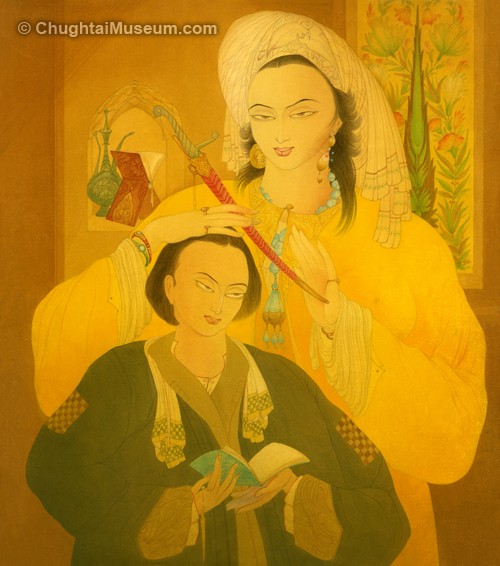
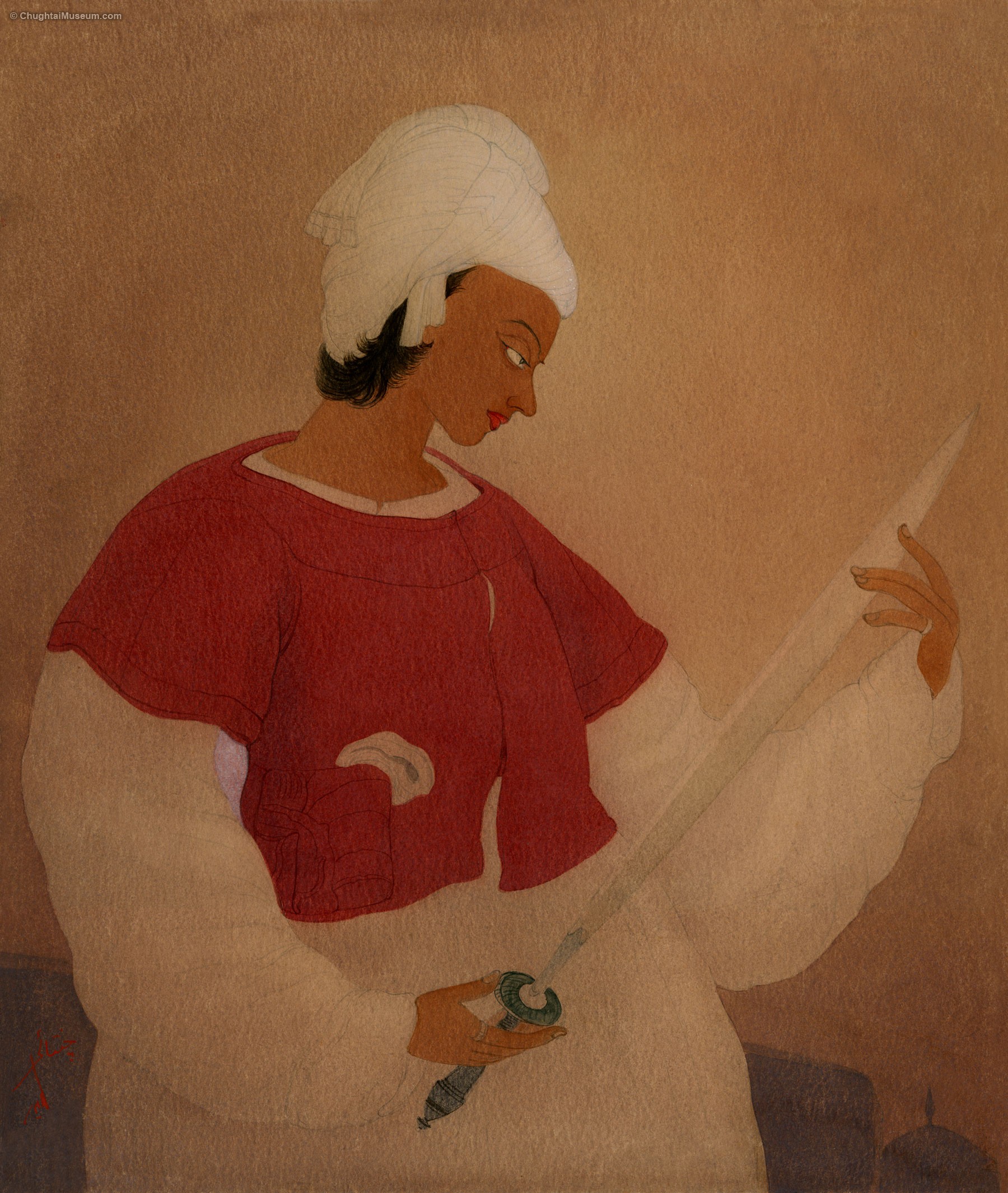
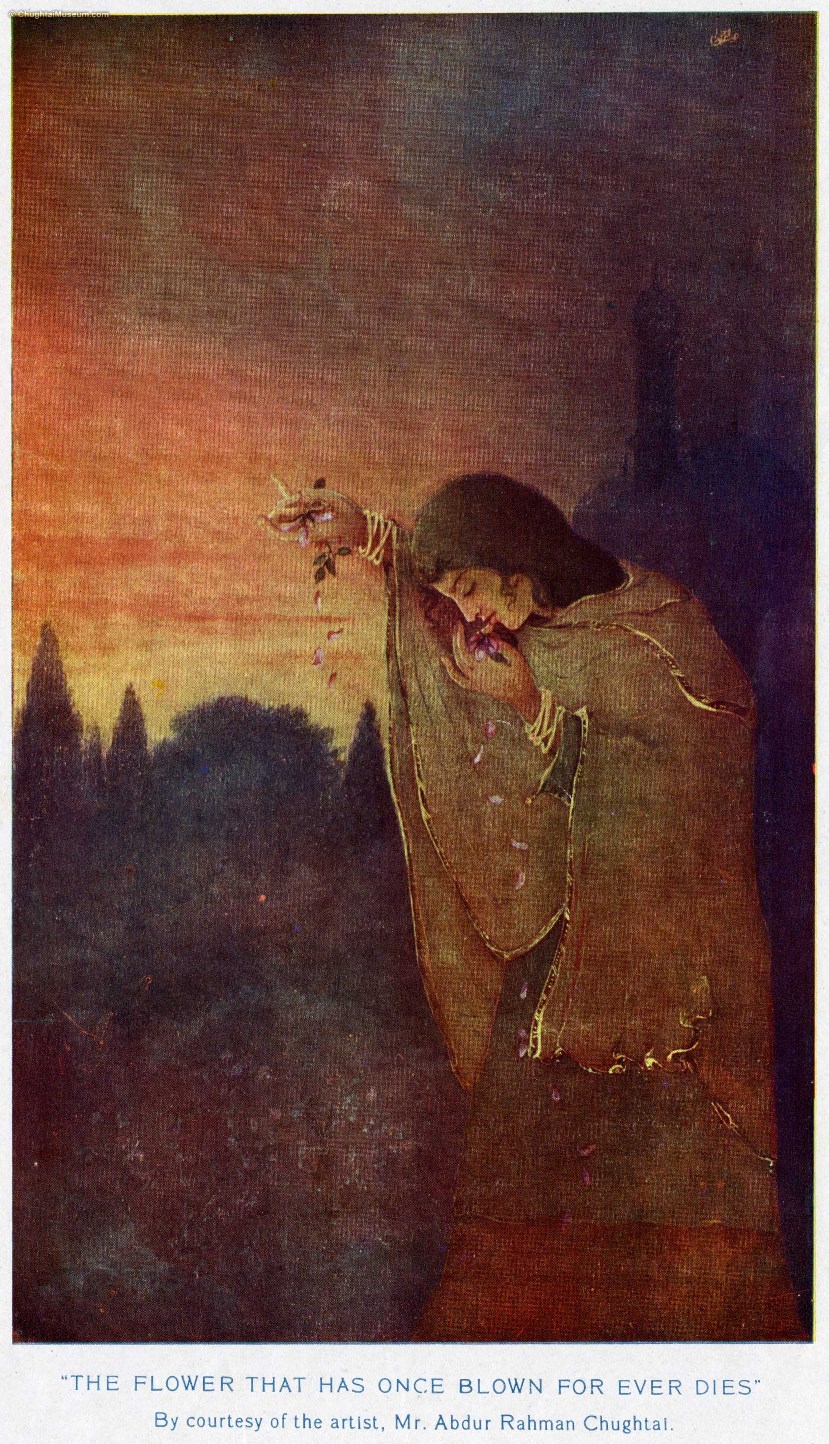
The immortal art work of a Mard e Momen reveals to us the ever readiness of the Muslim General. The sword is out of the scabbard and points to the defenders being prepared for all outcomes. Where as on the other hand, the mother who has lost her husband to shahadat, points out to her son, the will stemming from Quranic teaching and the sword being used to defend the Ideology of Islam. This image repeats itself in the Art of Chughtai all the time. The message very clear.
The-National-EmblemSharp-Sword
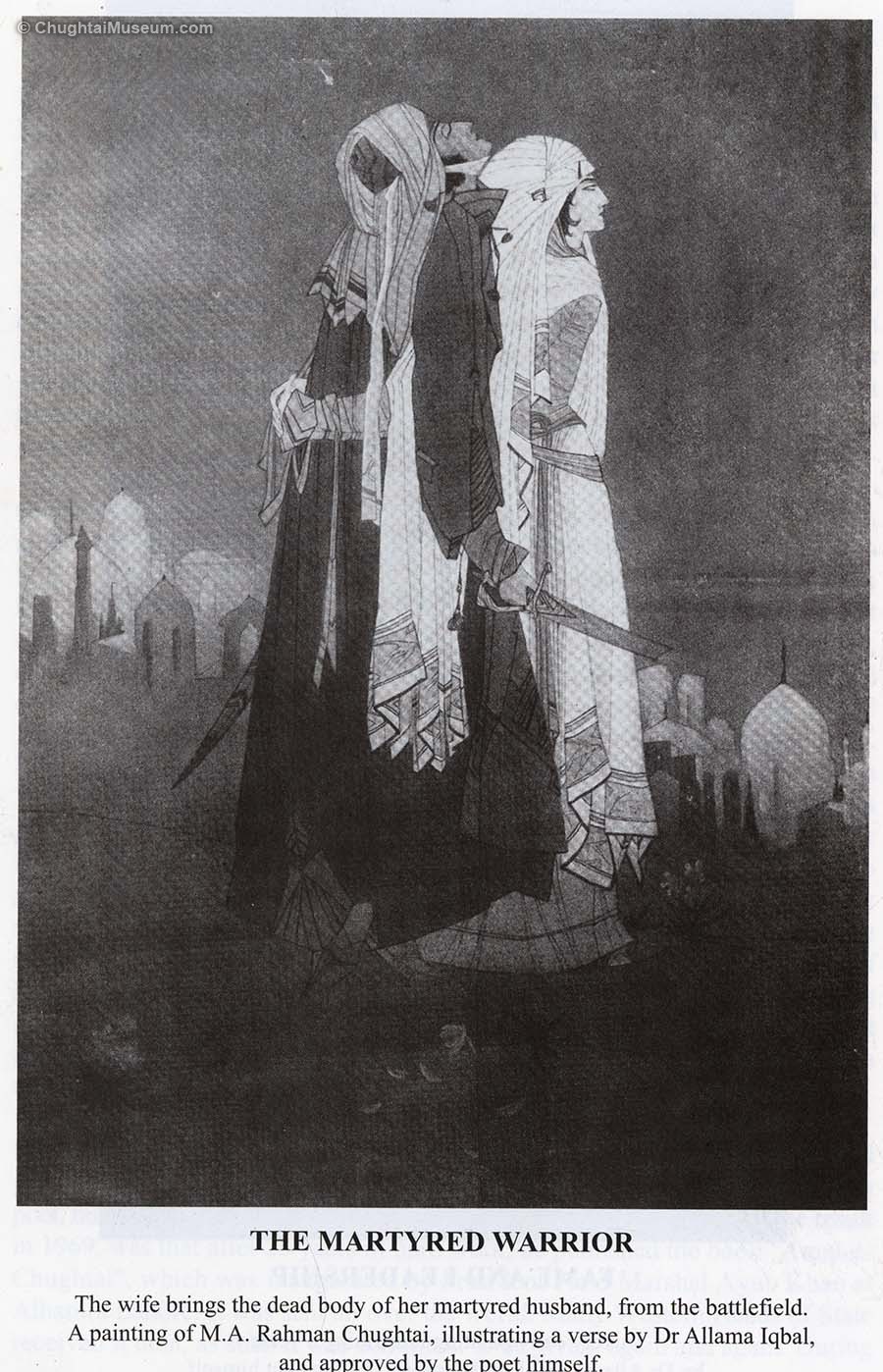
One of the rarest image in the Art of Chughtai is the work of a lady carrying the dead body of her warrior husband from the battlefield. I do not think this image of a dead person has ever occurred in Chughtai Art but here it is a real exception. And it is not a sign of death but an idea of defiance against evil designs. The sword of the warrior is broken showing that he fought till the last and embraced martyrdom for the sake of his Ideology of Islam. Such scenes evoke one to shout Allah o Akbar again and again. Enemies beware of the warrior unleased against tyranny.
BIGOTRY OF SOME HINDU WRITERS CLOUDING THEIR ABILITY TO JUDGE CHUGHTAI ART,
RIDICULING THEIR OWN SELF RATHER THAN THE ARTIST M.A. RAHMAN CHUGHTAI
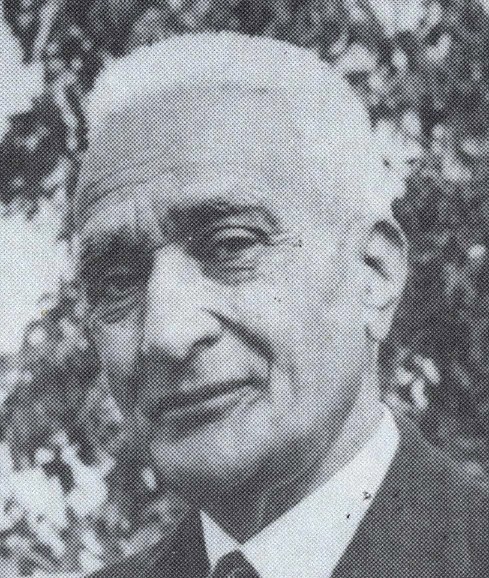
O-C-GANGOLY
The two nation theory never arose out of a vacuum. It was a fact which the Quran recognizes, as well as the writings of people like Sir Syed Ahmad Khan and Dr Allama Iqbal. Quaid-e-Azam through a political process put it into reality. Jealousy ran in the veins of some bigoted Hindu writers and when we read their analysis of Art, one can only hope that some sanity could have prevailed in their analysis of things.
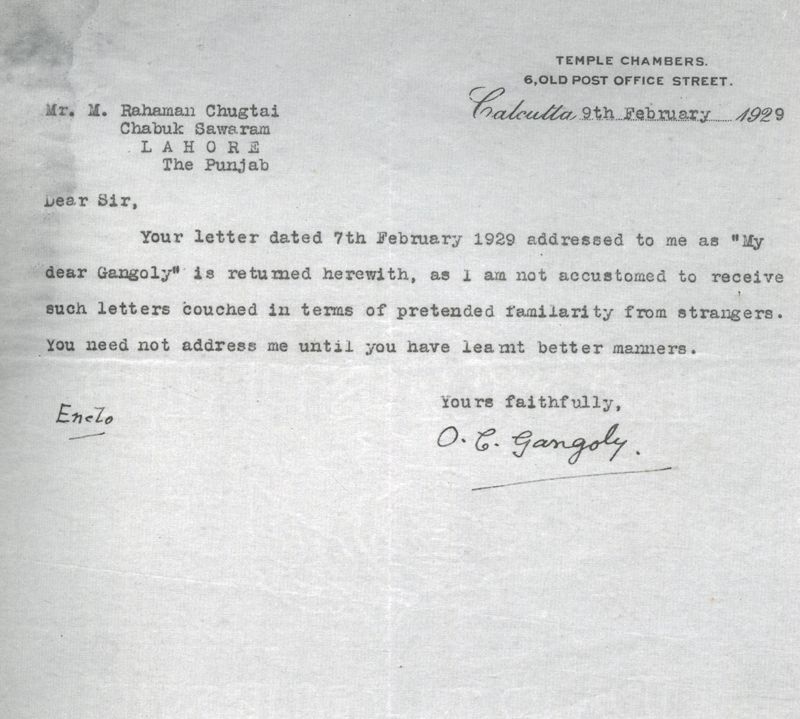
Chughtais-letterVenom in O C Gangoly
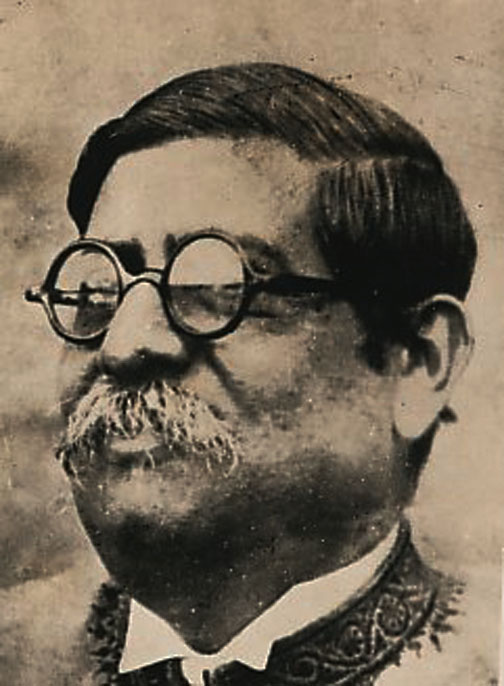
Take for instance the famous iconic Hindu writer O.C. Gangoly. We have written about him, but he left a record which will blacken his name forever. A request by Chughtai artist for return of his paintings sent to an exhibition show in Calcutta, evoked a sharp reply from him. We reproduce it for anyone to see. It clarifies what Chughtai wrote about all the time. Calcutta was allergic to Lahore and allergic to Muslims in total.
Tapati Guha Thakurta Calcutta
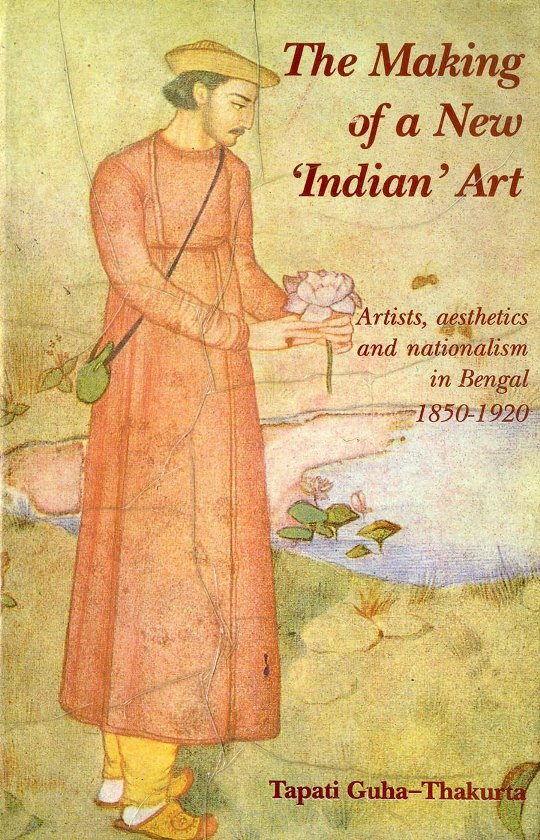
Tapati Guha-Thakurta is an enigma all her own. Cambridge University Press considered her a professional on the subject but could not see the bigotry she carried on herself. Again Calcutta. In just one book “The making of a new Indian Art”, she felt reluctant to give an image (it would expose her thesis) of even one Chughtai’s work but she mentions him at least three times, in most derogatory manner. Her first remark about Chughtai is on page 291 of her book. She says:
“Abdur Rahman Chughtai’s compositions of the first years, with their recurrent images of flickering lamps and swooning women, cannot rise above such CRASS MANNERISMS.”
Her venom cannot be put on rest. She repeats another blatant assertion:
“For example, couplets from the Rubaiyat of Omar Khayyam conjured an atmosphere of Persian exoticism and mystique around Chughtai’s images of veiled women, fading lamps and scattered petals. It is not clear whether the quotations from poems came from the artists themselves or whether they were later additions by critics and editors to help in the propagation of these paintings.”
Tapati Guha Thakurta
And thirdly she makes fun of the painting FAME based on National leadership, as a ‘symbol of the feebleness and self indulgence of India’s national leaders’. Based on a verse by Dr Allama Iqbal, she had no mood to accept that work. So what? It was Chughtai’s view, not hers.
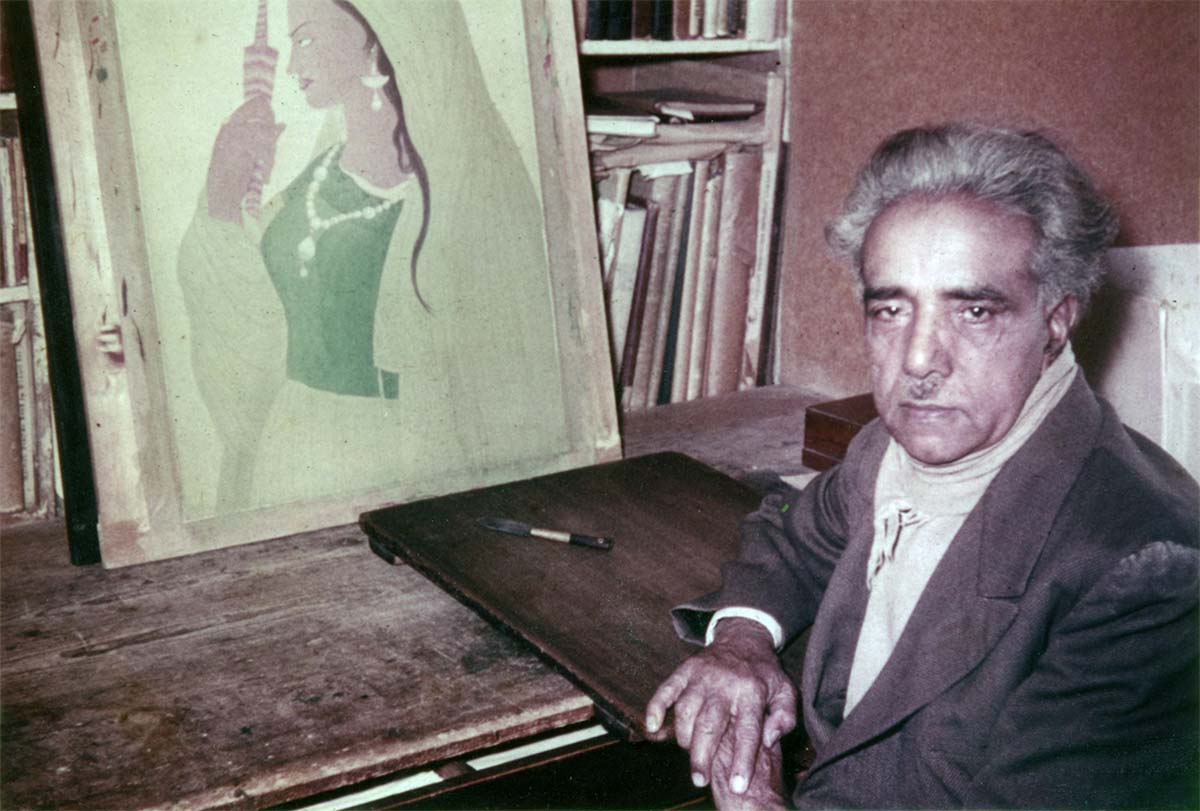
And for now, we finally come to the venom of Som Anand “Portrait of a lost city”. This man has in his total hatred, uttered such words that no sane publishers would have allowed the publication. Som Anand talks about his visit to the studio of Chughtai. He makes fun of the Punjabi language, spoken by the artist. But of all things he terms Chughtai as:
“The man was very shabbily dressed. His dishevelled hair and unkempt clothes made him look like the domestic servant of a middle class family. An interesting thing about his clothes was that the many colours were splashed on his shirt sleeve. It seemed that he used to wipe his brush on the shirt while he was at work.
To me the most striking thing in this conversation was that he spoke in very simple Punjabi and his unsophisticated accent sounded almost like the speech of an unlettered villager.”
Som Anands father
There is so much falsehood in his writing that Som Anand is not even ashamed of writing false things. The whole episode is made up of his own conjectures. A senior Professor of GCU, Mahmud Ahmad told me that no gentleman could talk like that. He said if you ever meet Som Anand, just slap him even before you talk to him. I said certainly I cannot do that, as I do not have the inferiority complex these kind of Hindus carry in their hearts. It continues to pain them that Muslims ruled the region for more than 1200 years. They made a mess of their country in a few decades, and triggered, manipulated mess in ours. . That complex does not go away.
THE SIX INSCRIPTIONS ON THE AKBARI BRIDGE JAUNPUR OF MUNIM KHAN
A FORGOTTEN NADIR UL ASAR USTAD AFZAL ALI KABULI ARCHITECT OF SAME
Shahi bridge
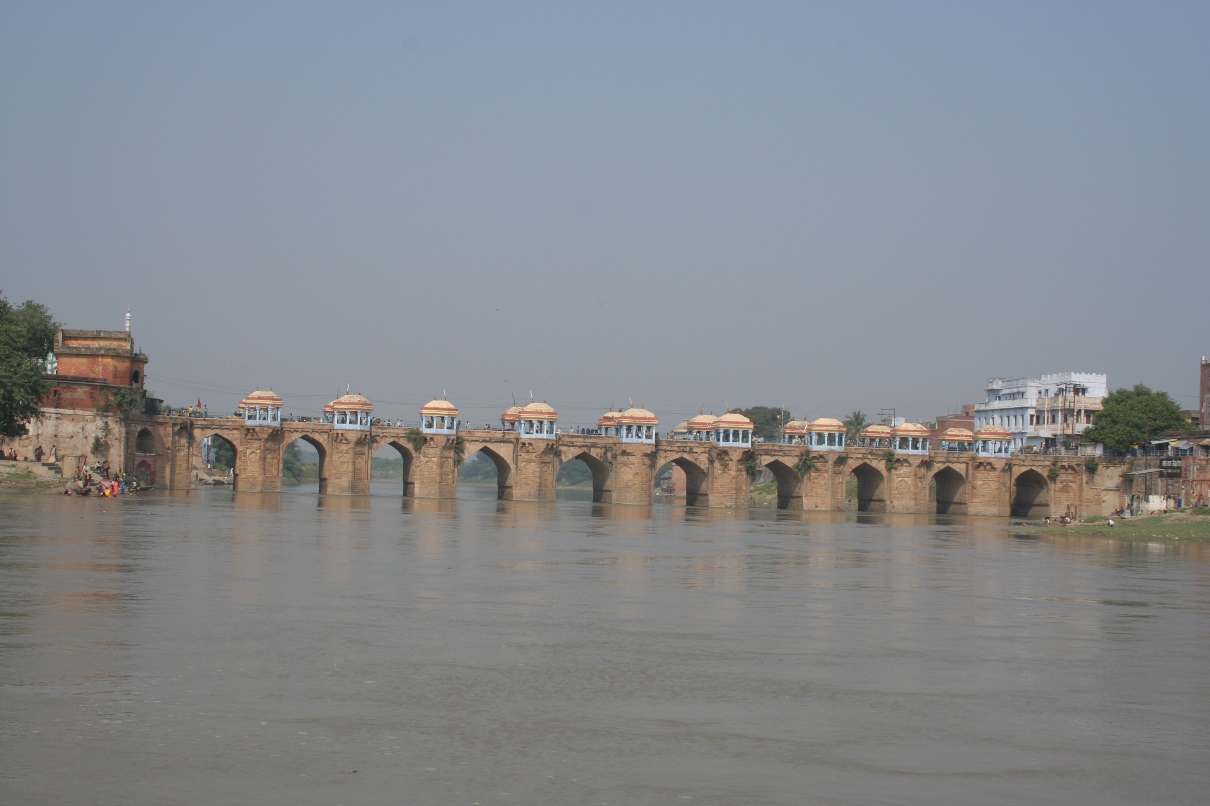
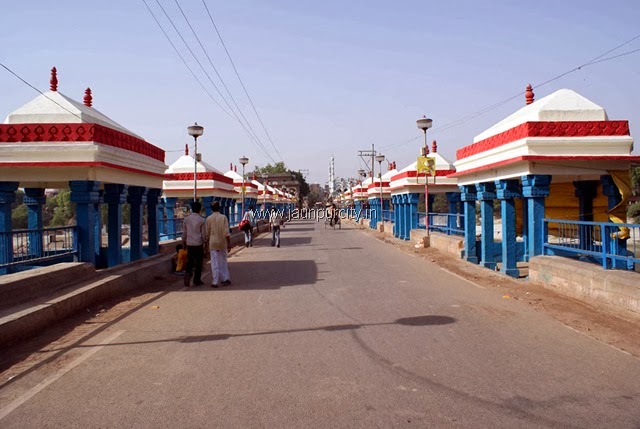
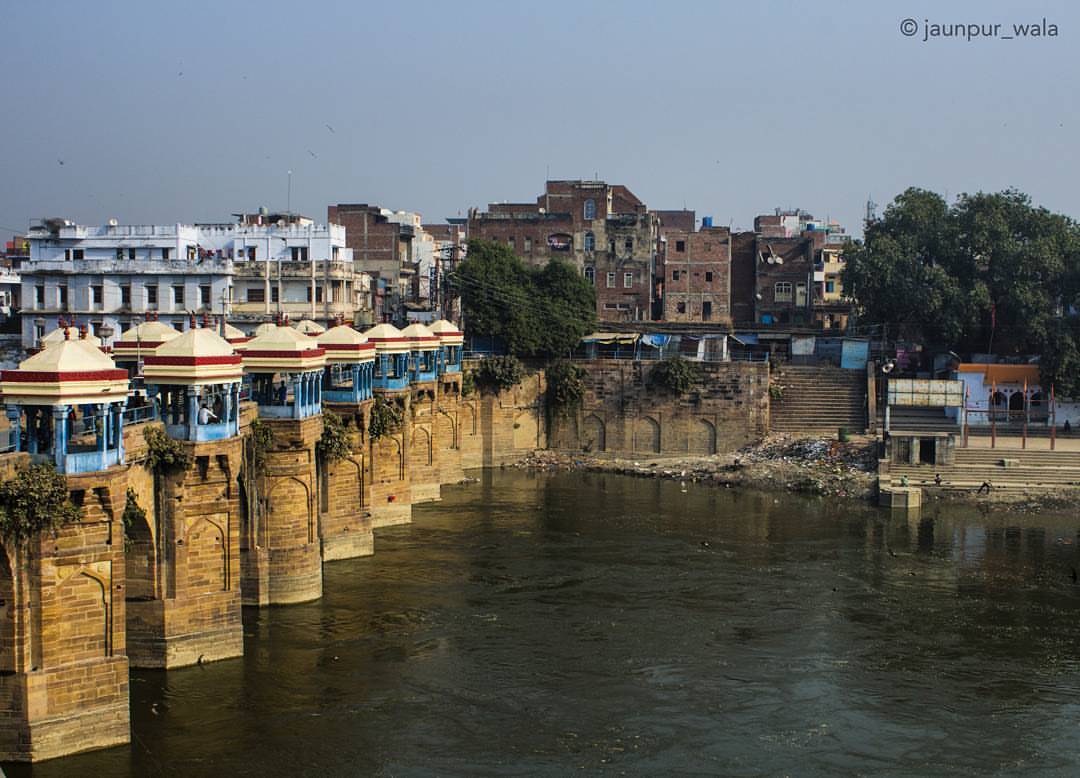
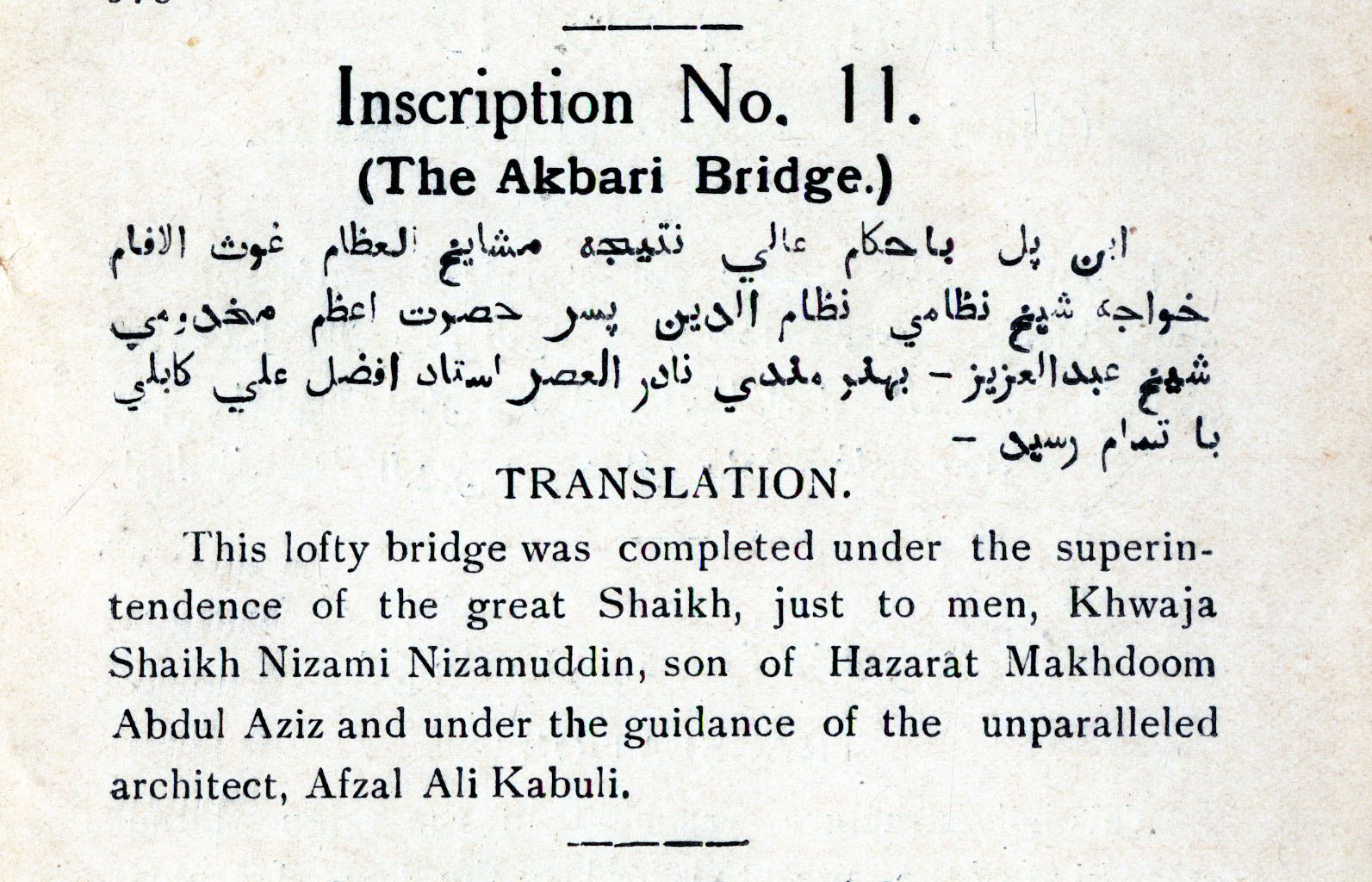
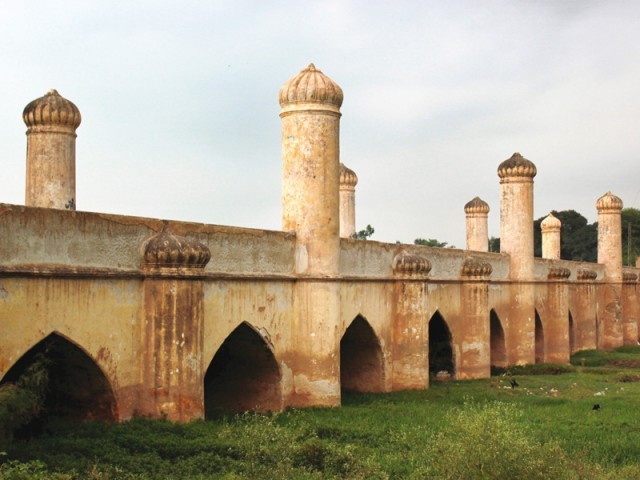
The year was 972 AH (1564 AD) and Emperor Akbar was crossing the river in Jaunpur. A wailing old woman whose son was left across the raging river caught the attention of Emperor Akbar and he immediately ordered Governor Munim Khan to build a bridge on the same river. The bridge took four years to build and there are six inscriptions on the same. Recorded by people in the past, one has no access to same today. Our pleasure to attach the one with the name of the Master Architect from Kabul, who made the same.
Akbari Bridge JaunpurJaunpur bridge Akbari
Mughal bridges are an interesting study in itself. And the different forms call for versatility of the builders. It is worthy of comparison with the Bara Bridge built by Lutuf ullah Ahmad Muhandis in Peshawar. Kiosks difference mainly as design element. A study is over due.
Inscription Akbari bridge JaunpurStatue at one end of Akbari bridgeBara bridge Peshawar
OUR MASTER PAINTERS ON THE SAME TRAGIC THEME OF MUGHAL HISTORY
THE DEATH OF EMPEROR SHAH JAHAN BESIDES HIS DAUGHTERS IN AGRA FORT
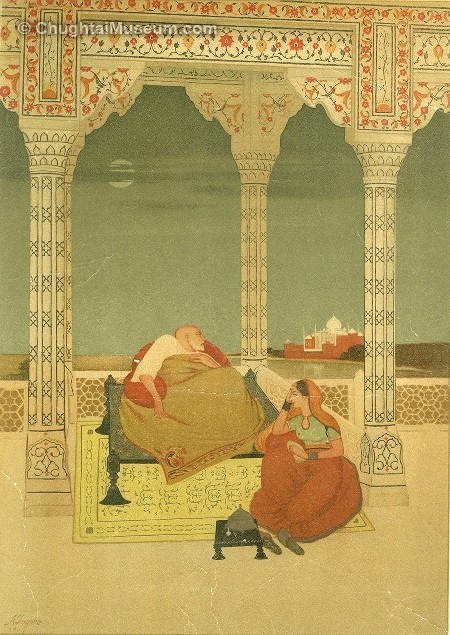
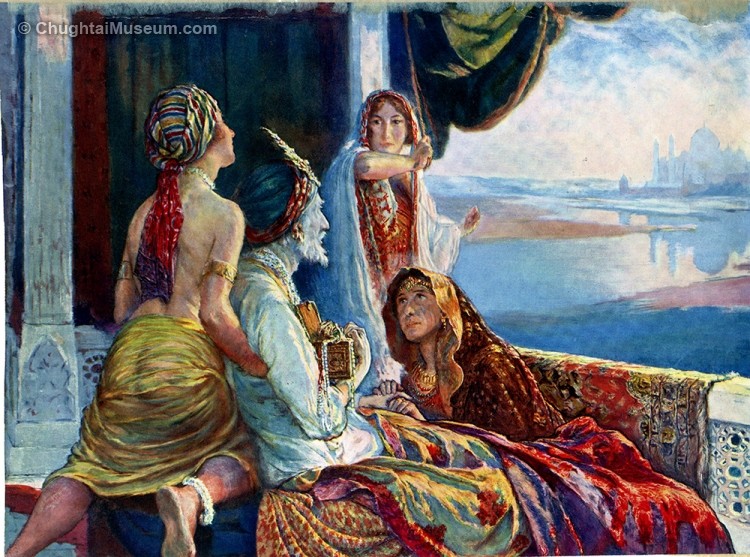
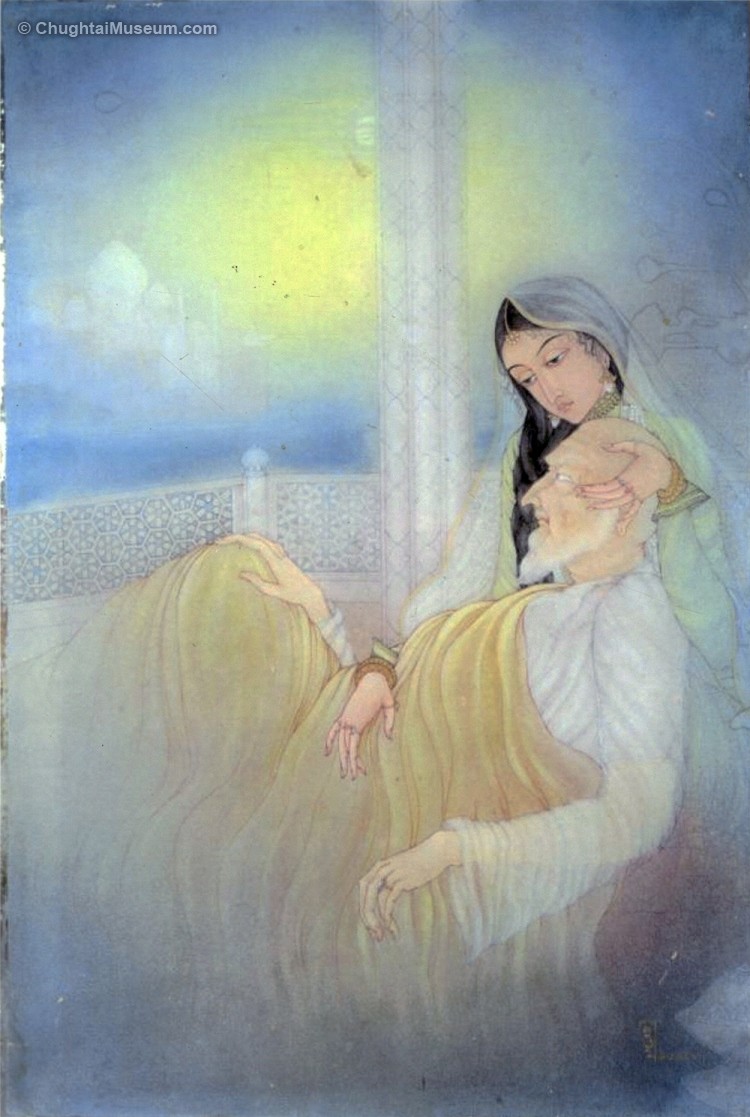
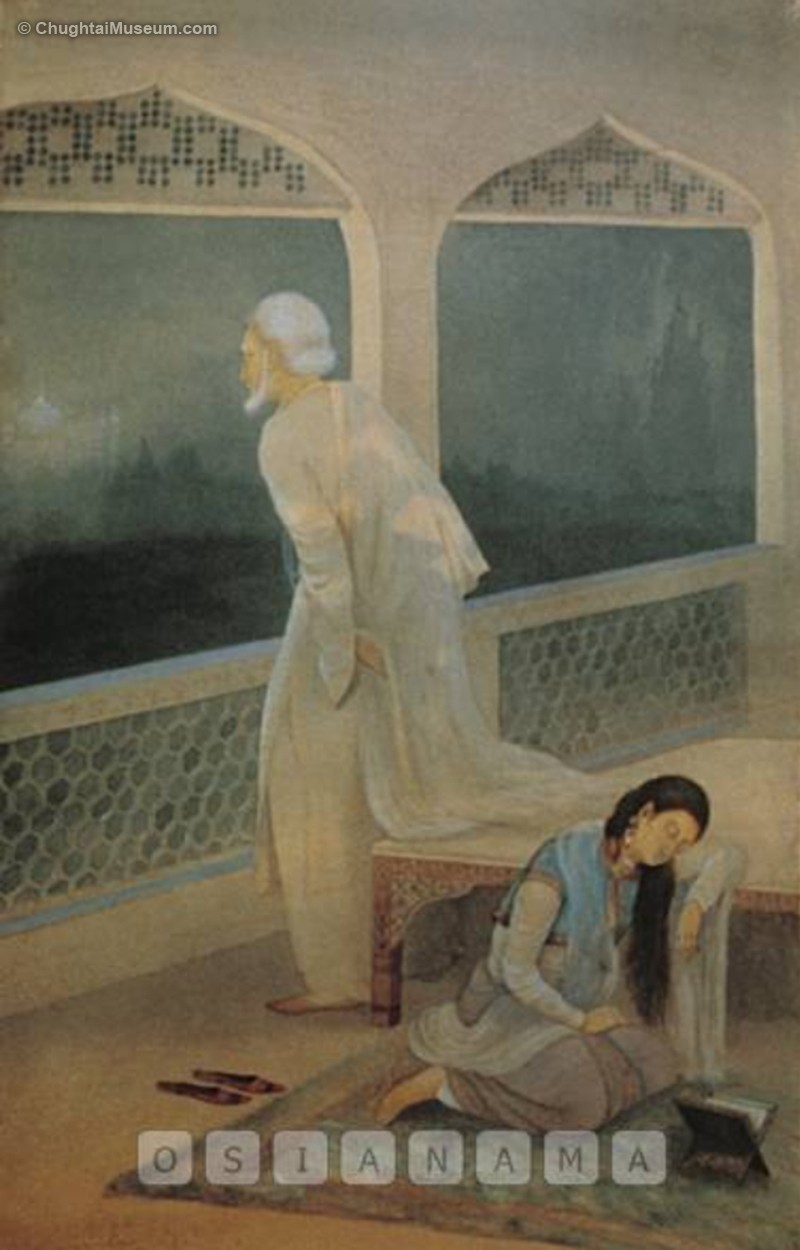
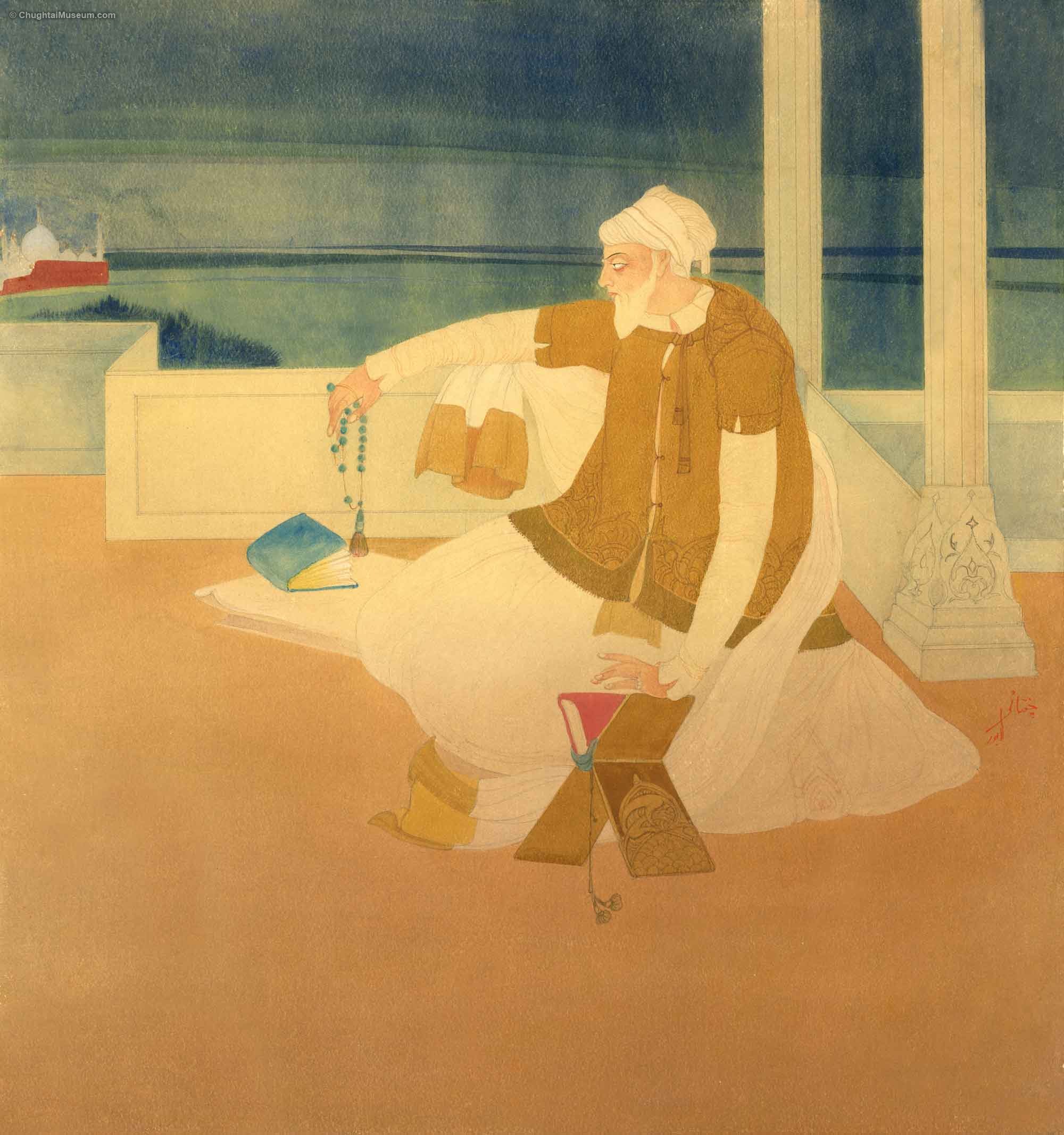
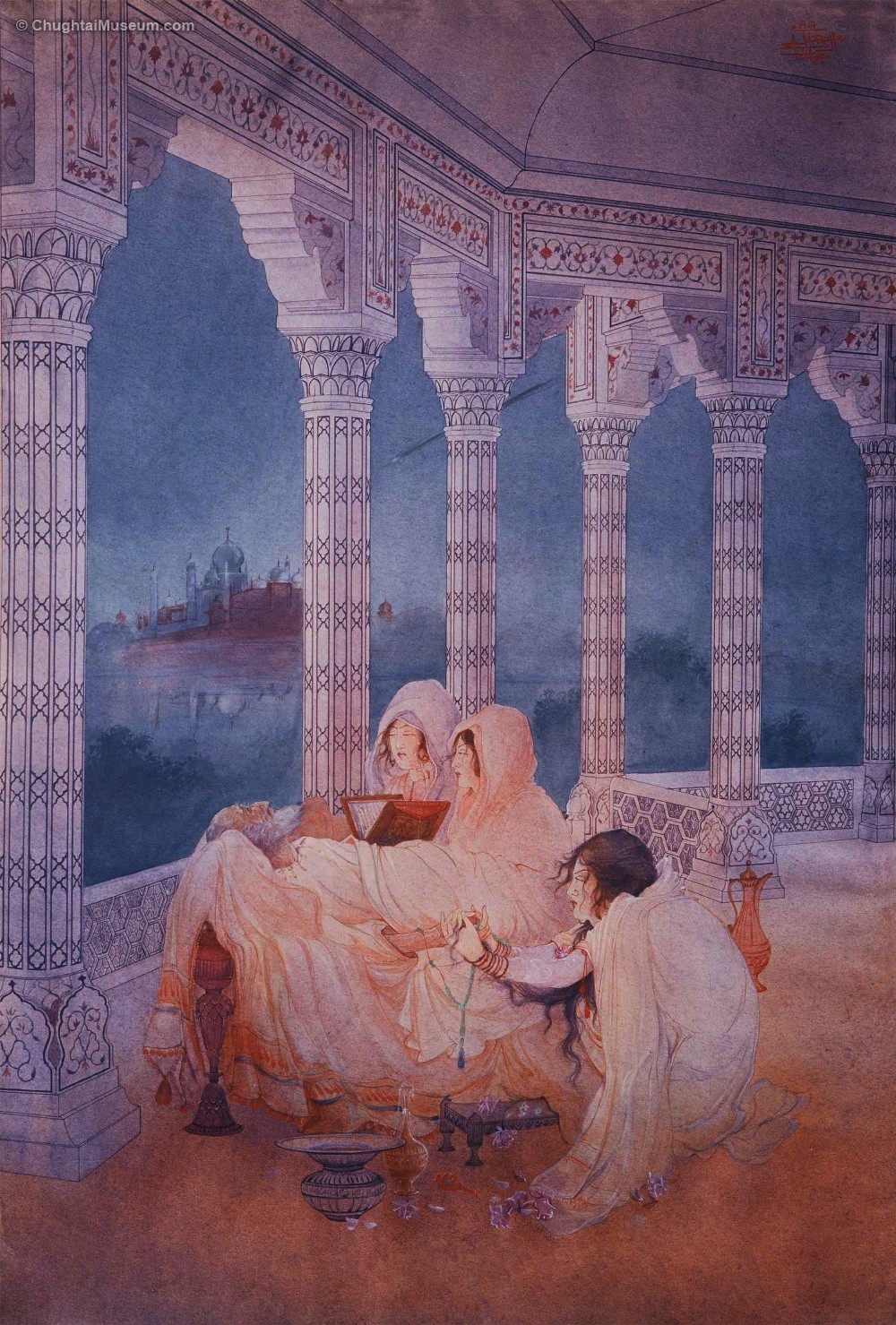
The house arrest of Shah Jahan in Agra fort is stuff of history and stimulated many artists, both from here and abroad. Each has
Passing of Shah Jahan Tagore version
presented their viewpoint on the passing of Shah Jahan. The tussle between Abanindarnath Tagore and Abdur Rahman Chughtai is full of history, when Chughtai proclaimed that Tagore’s Shah Jahan did not look like a king but washerman, surrounded by his washing girls. The Mughal charisma could not be felt by Tagore. A complete book has been written on the subject, but here just check the different versions. A number of forged and fake images of Chughtai are also present on the internet and the same are clarified here for researchers.
A poignant moment of history recorded by visual Masters of the region.
Last days Cecil Burns versionLast days forged versionLast days Shah Jahan Unknown artistMourning-of-Shah-JehanPassing-of-Shah-Jahan
EVERY DAY YOU HEAR PEOPLE PREDICTING THE FUTURE NULLIFYING ALLAH’S RAHMAT
HUMAN BEINGS ARE ASHRAF UL MAKLOOQAT ONLY BEINGS GIVEN POWER OF CHOICE
Asma-Husna-by-Miran-Baksh-Naqash-Lahori
The creation of Allah is infinite. Living things abound in life but they are not provided with freedom of choice. Allah has gifted human kind with some thing a quality no other being has in existence. The power to make choices. Choices which can lead any where. And with these choices, the power of prediction is zero, mere speculations. If this power was given to human kind, the whole concept of right and wrong will go in one sweep. The Quranic law of Makufat tells us that if you make virtuous choices, the results would be good. If you make evil choices, the result would be bad in all ways. And not only individual choices, but the choices society makes lead to same results.
Mirza Ghalib in the famous verse tells us that when a horse rider puts one foot in a stirrup, he does not know whether he will live to the moment of putting his foot in the other stirrup. M.A. Rahman Chughtai in his painting LIFE illustrates it in different way. There is a floating lotus with a lamp on a lake or river, and the water waves are jostling while taking it away. One does not know when the water will reach the floating lamp and extinguishes it forever. That is life, unpredictable!
When Allah has not given us even the knowledge of our death, how can Allah give us the date of the death of the world? Qiamat is only understood by Allah, we have no capacity to know same. Behind every rickshaw on the street, as well as huge flexes on walls, we see bearded ones giving us lectures about their spiritual powers. Impressions being generated for morons in our society. So unfortunate that instead of guiding people, putting them astray in society.
LIFE
A point forgotten by all when talking about the IDEAL SOCIAL SET UP generated by Islamic government after the demise of our Prophet (PBUH) is that all their efforts came from the QURAN itself, and any ijtehad the people in power could think their way out. It was DEEN (a way of life) in full swing. Riyasat ul Madina as people at times term it, was made possible, for there were no conflicting hadees at that time. In fact there were no hadees at all, there was merely the Quran. Probably the first hadees came around 232 AH. More than two hundred years nothing was there to mitigate Quranic thinking. Clarity was the key to Islamic state.
Allah has given us options and requires us to think and ponder and find a way out of all dilemmas. Our sacred duty is to do that. Yes Allah tests us all the time and we have to rise to the occasion all the time. Janat is endless struggle, janam is end of everything.
A SHORT EPISODE IN LITHOGRAPHIC TRAINING OF M.A. RAHMAN CHUGHTAI
THE ARCHAEOLOGICAL SURVEY OF INDIA HEADQUARTERS IN CITY OF CALCUTTA
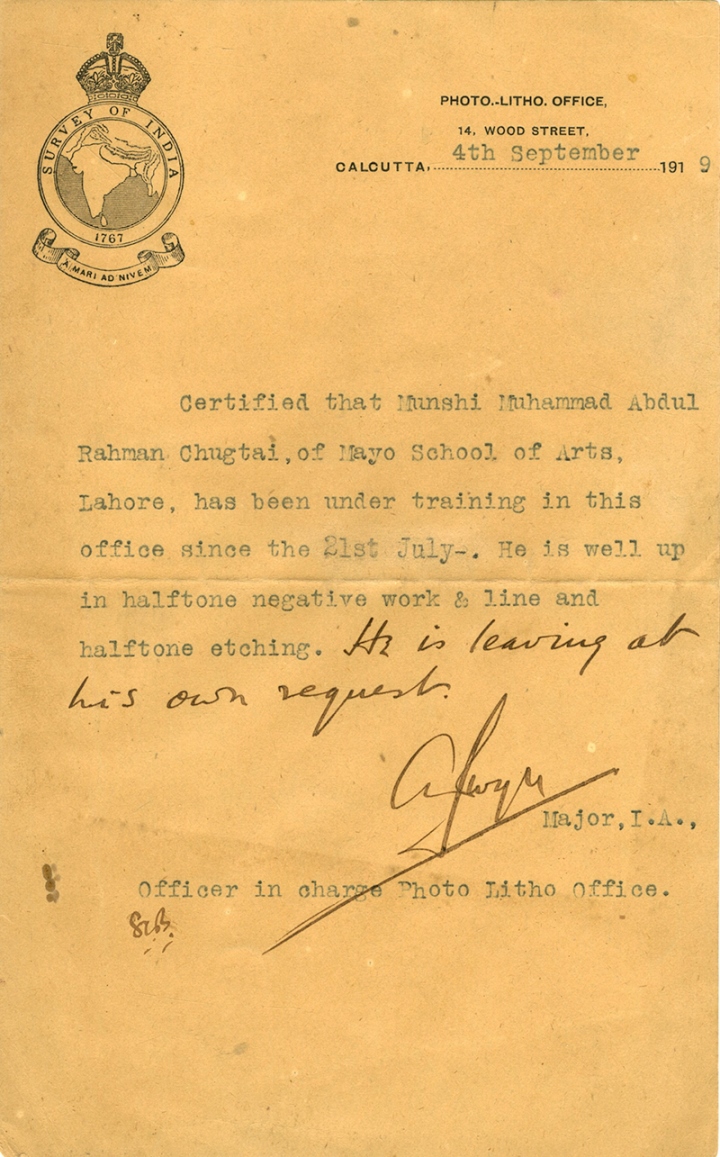
21ST JULY TO 4TH SEPTEMBER 1919 A TOTAL OF AROUND 43 DAYS OF ETCHING
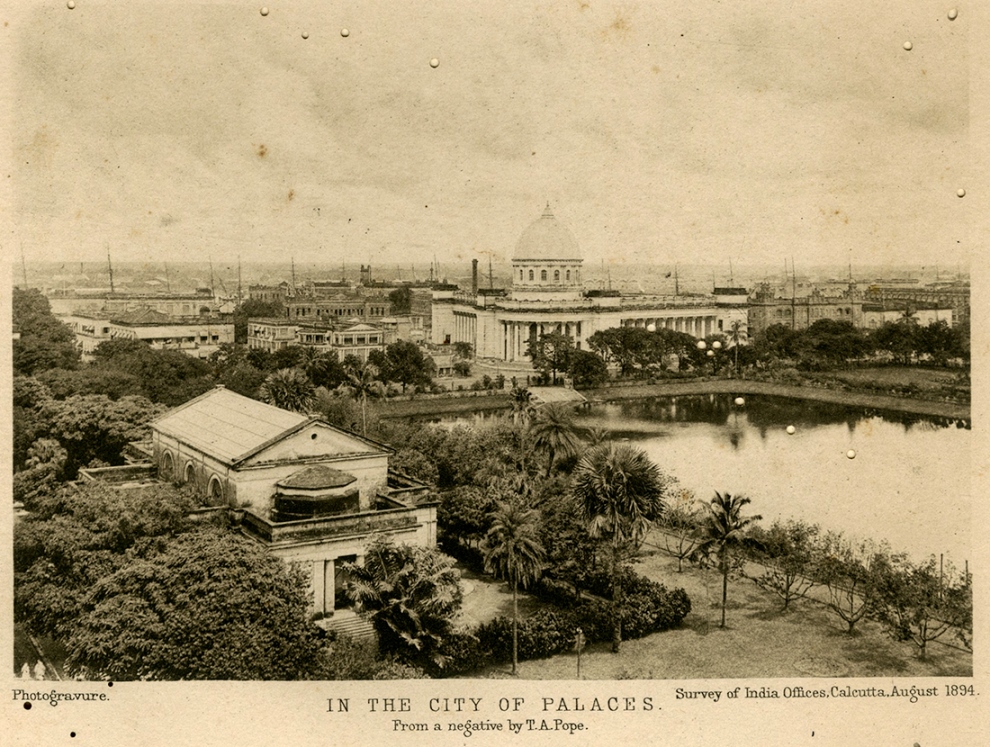
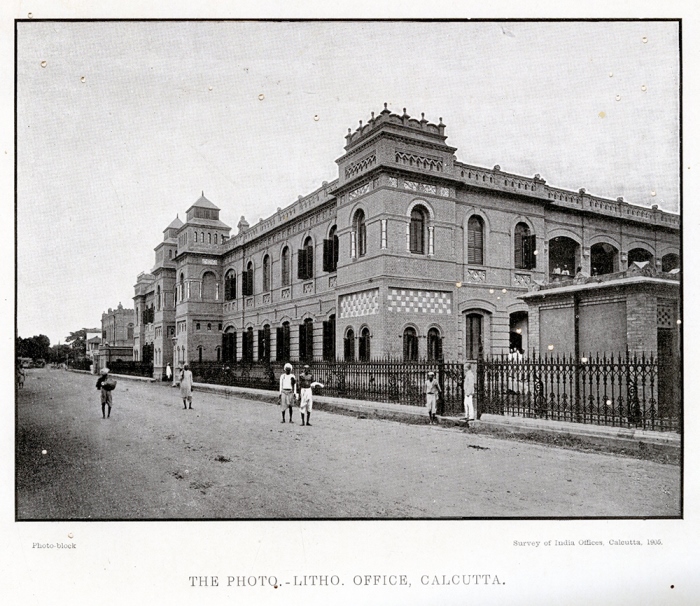
Archaeological Survey Headquarters
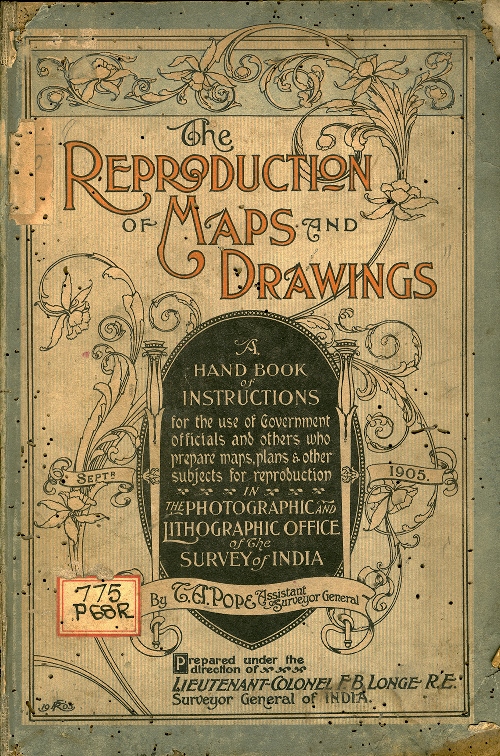
M.A. Rahman Chughtai studied Photo-lithography at Mayo School of Arts and was later put in charge of the same department. To polish his skills, he was sent to the Photo-lithograhy department of Archaeological Survey of India in the Summer camp which lasted from 21t July to 4th September, 1919. Not having enough resources to stay in some fancy place, he was a paying guest of an inn keeper, that is a small tandoor in the city. He was in a hurry to come back to Lahore. He did not like to stay there far away from his home.
Lithography Section of MARCLithography Instruction Manual
There for holidays collected Master Hussain Baksh originally from Lahore (famous artist of Agha Hashar theatre), Master Sher Muhammed and others. Chughtai Sahib was in no mood to betray his visit but he accompanied all the other artists to Shantiniketan, where they met the artist, Abanindranath Tagore. Contrary to the prior promise that his identity will not be revealed, the companions blurted out his name, when Tagore asked them about the artist from Punjab, who was publishing works in magazine Modern Review Calcutta. And that is where the FIRST CONFRONTATION took place when the Bengali Master called Chughtai Sahib Kabuli wala in a demeaning way and made jest of his large hands like an iron smith. All those morons who talk of this visit in the insulting way of perhaps Chughtai Sahib being a student of Tagore can learn much by reading about the happenings there. But that is a separate topic and we will talk about it later.
The relation with Tagores is a separate tale with its own merits.
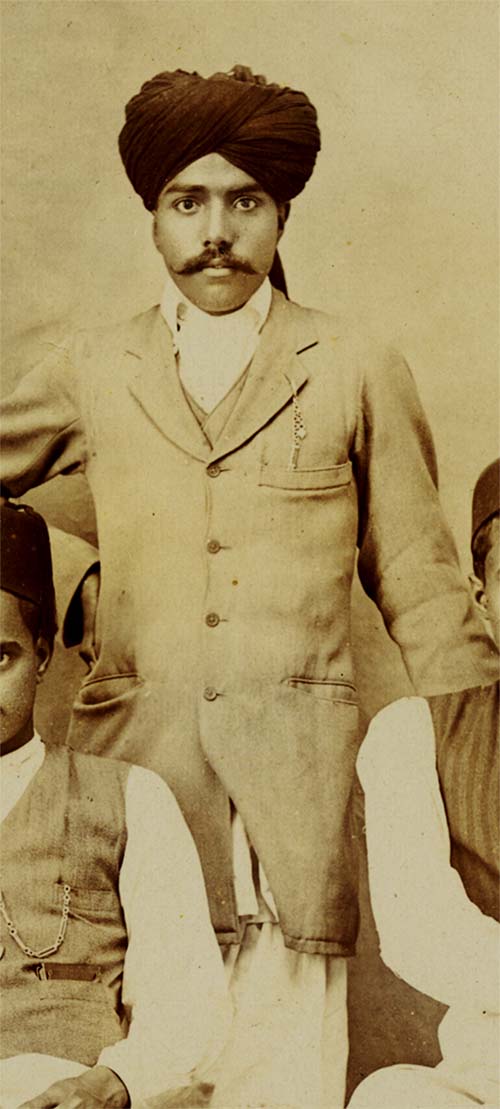
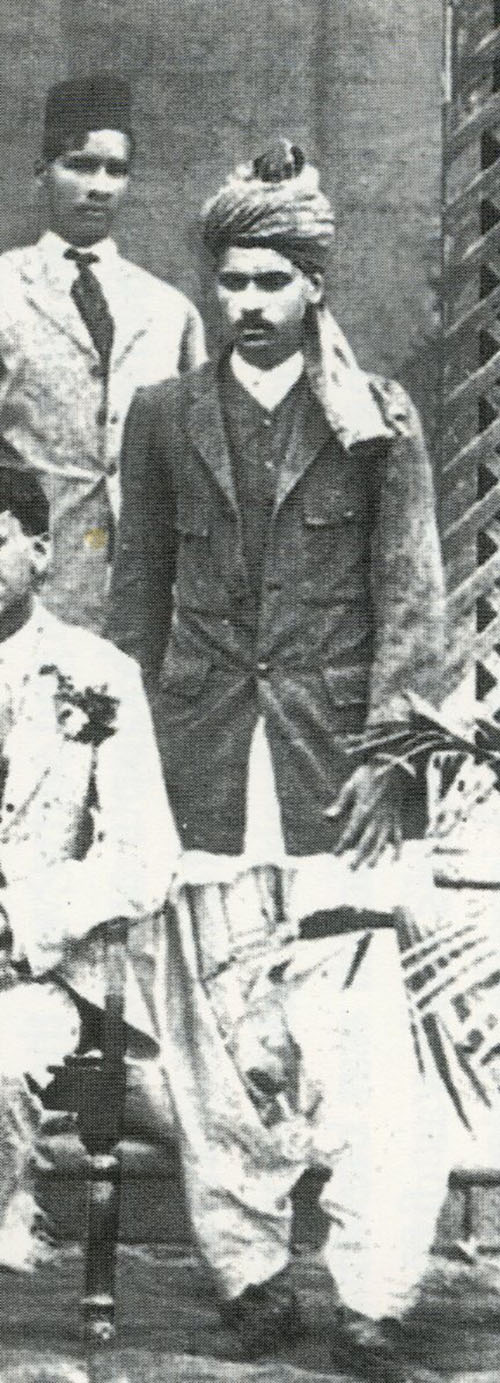
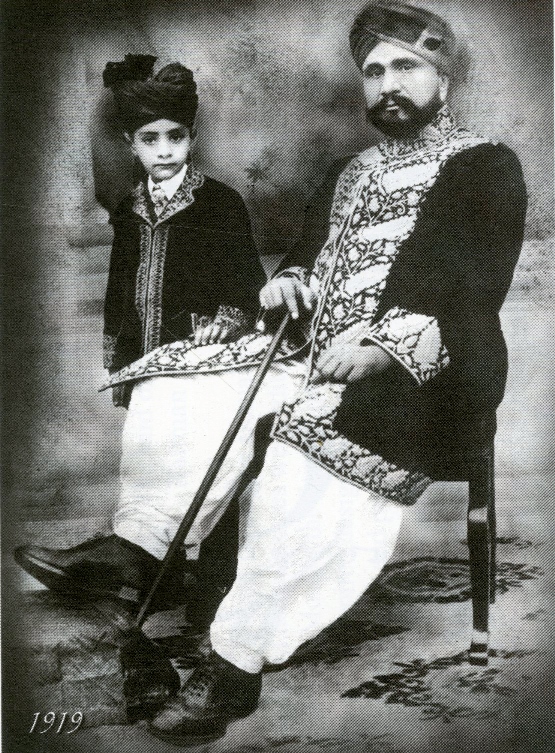
On the compounds of Wazeer Khan mosque and the Naqashi School of Baba Miran Baksh a photograph taken with the back of M.A. Rahman Chughtai and in the distance (group of three) stands a relative Mian Abdullah and the two brothers Abdullah and Abdur Raheem. An amazing memory. Chughtai stands with a senior unrecognized but could be Fazal Din Sahaf. Then on his first marriage day with the other two grooms. Group photograph. Again so rare, obtaining it was a miracle. Then a group photograph at Mayo School of Arts, stands Chughtai artist with his brother Master Abdullah. And then a professional photograph done by a friend of his at that time. The same photograph made into a painting by another artist Mian Abdur Rahman.
Photographs keep alive images long gone and remind us that the same are necessary in the memory of keeping things alive. Enjoy!
MARC under fifteenMARC under eighteenMARC under twenty
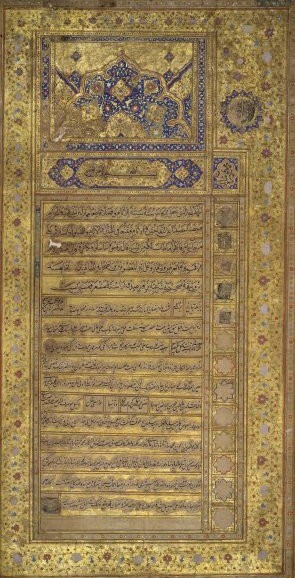
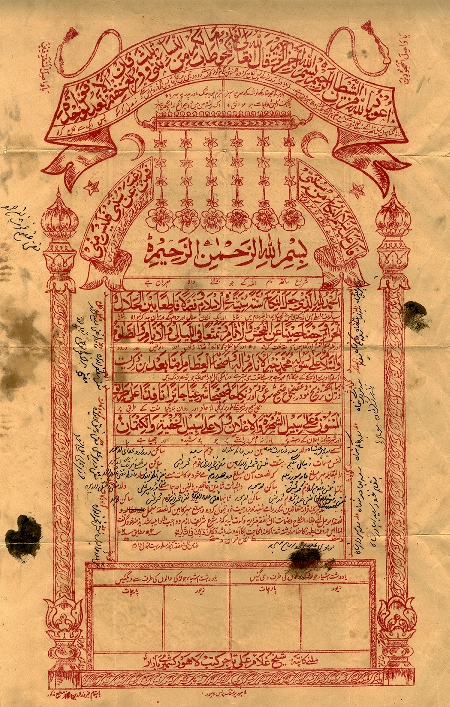
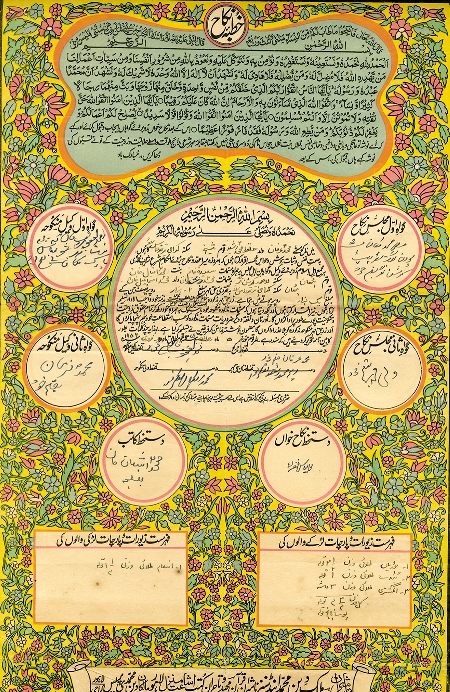
THE IMPULSE TO ADORN NIKAH NAMAS WITH ISLAMIC AESTHETICS
TRADITION BEING REVIVED AT PLACES AND ROLE OF LAHORE ARTISTS
Iranian nikah nama
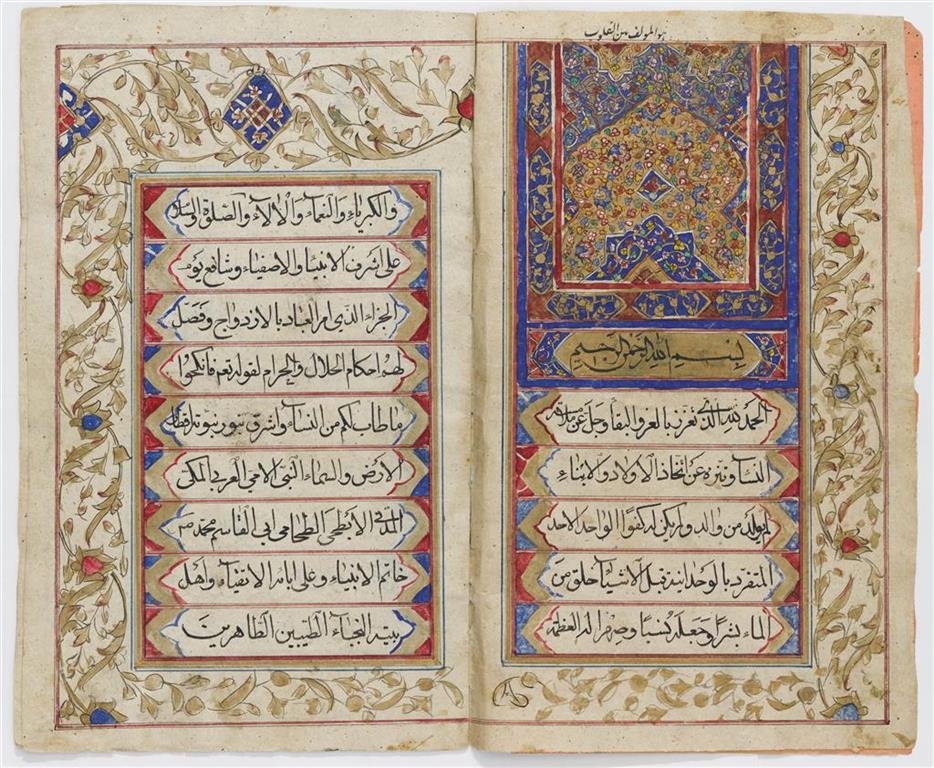
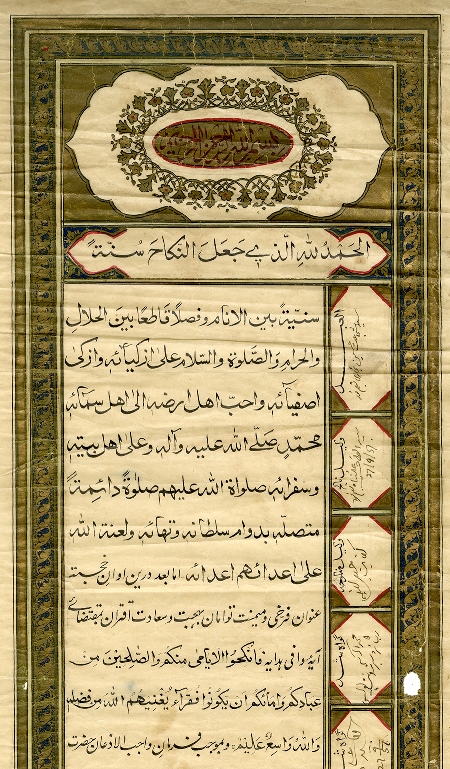
Ordinary people got married at simple functions, where there was nor even a written record of a marriage. People collected together and witnessed a marriage. Then when women were deprived of their legitimate rights, things started to get on record. The British period in Lahore led to registration of nikahs. Lavish displays were not for any record. The nikah namas evolved in Lahore from hand drawn documents to printed ones. Designed by various artists in Lahore. Baba Miran Baksh and his son Muhammed Hayat Naqash also used to draw these forms with traditional naqashi and were sold for around Two rupees at that time. A full fledged nikah forms business was there in Lahore with various designs for them.
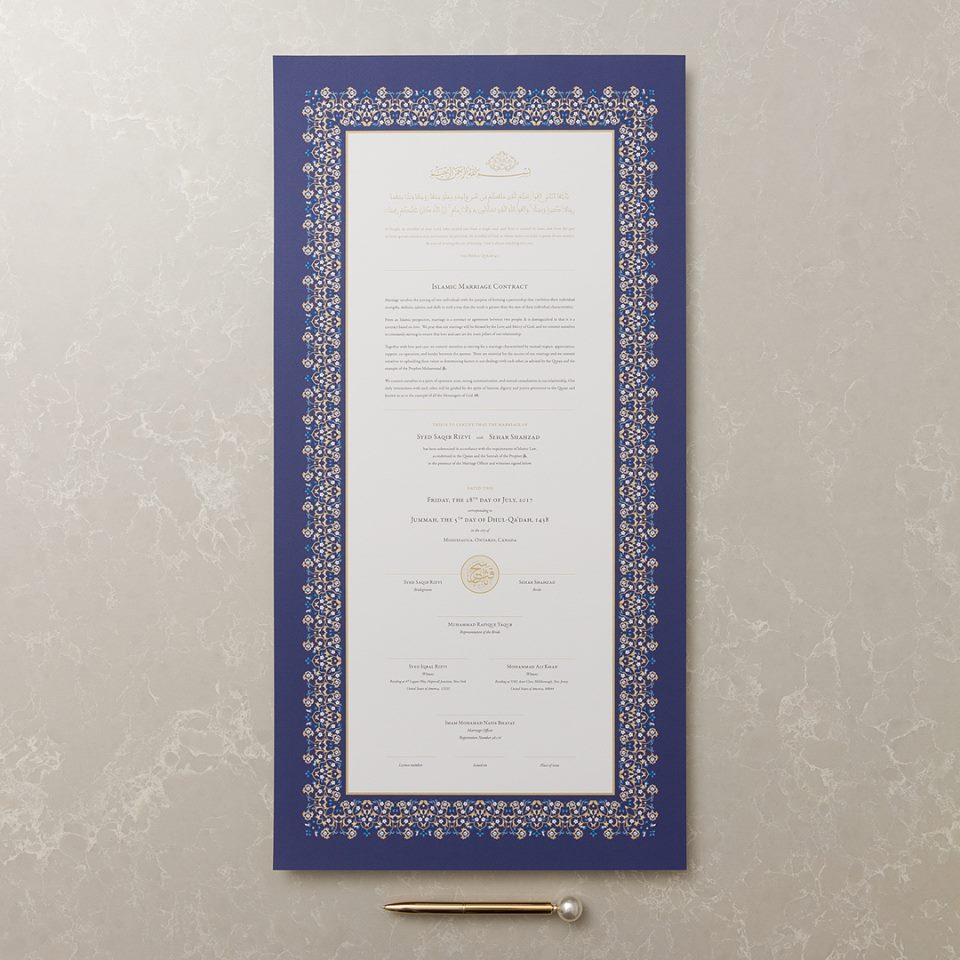
Farooq Ishaq designer nikah namas Lahore
Farooq Ishaq and Umar Shazad are the new designers from Pakistan. A form to treasure should be as beautiful as possible. Satanic minds in international circles are making a taboo of marriage itself and innovations to break the sacred contract are there ever more. The devil initiated concepts like SAYING NO TO HUSBAND and SAYING YES TO OTHERS. Adultery is no longer a crime in India in these new shape of things. Utter shame for any judicial system to sabotage sacred bond of human beings. And then initiating same sex marriages as a sort of romantic undertaking. It seems that Western powers want to erase the blessings of Allah on our society. The curse of Allah is not far behind Satanic minds.
Nikah nama of Bahadur Shah ZafarNikah nama Lahore 1Nikah nama Lahore 2Hand drawn nikah nama Lahore 3Umar Shahzad nikah nama designer
A FUNCTION IN LAHORE 17TH FEBRUARY 1917 IN COMMEMORATION
KHAN BAHADUR TITLE SIRAJUDDIN PUBLISHER KASHMEERI BAZAAR
INVITATION OF YOUNG PHOTOGRAPHER ABDUR RAHMAN CHUGHTAI
Khan Bahadur Sirajuddin 1917
Photography was a passion with Abdur Rahman Chughtai. He had got his hand on a wooden box camera and he fitted plates in it, and photographed many famous families of Lahore. Some of them still had plates he made, as well as photographs he did. In a very interesting way his specialty was colouring the black and white photographs with a spray pen of aerograph. His aerographic spray became famous in Lahore. One of his most famous work was that of an Englishman, who was Director Education in Lahore. His colouring of Dr Allama Iqbal’s work is well known.
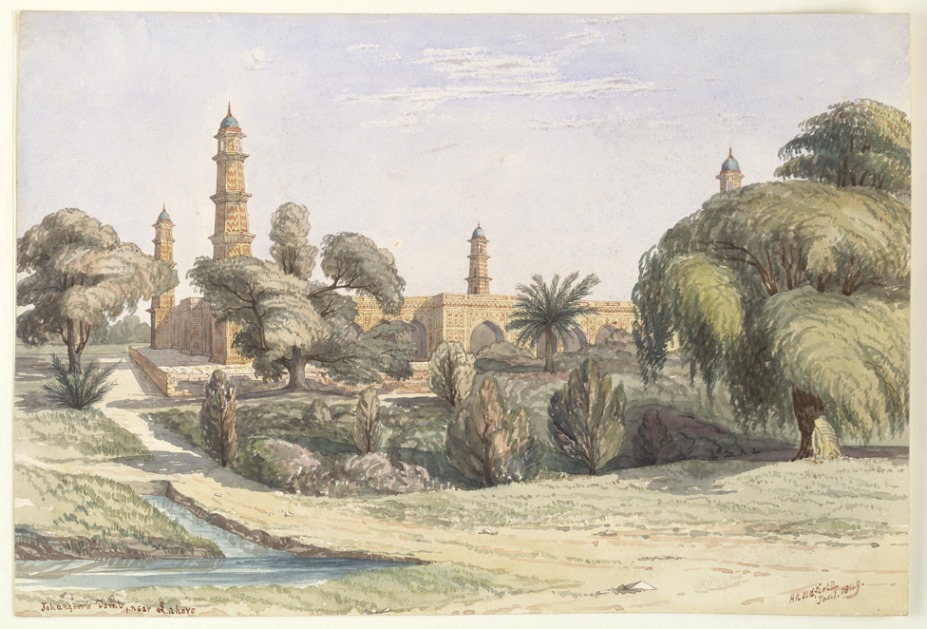
Jahangeer Mausoleum
There was a function at Jahangeer’s mausoleum in Lahore to celebrate the award of Khan Bahadur title to publisher Sirajuddin of Kashmeeri Bazaar. The artist was there in a group photograph but that went missing in time. In any case there is some record left and we can share that in time. A famous family of Mochi Darwaza too retained these plates till some time back, but when they shifted their house, we lost track of them. We do know that the son of that person used to work in united Bank Limited. If they read this. they can get in touch with us.
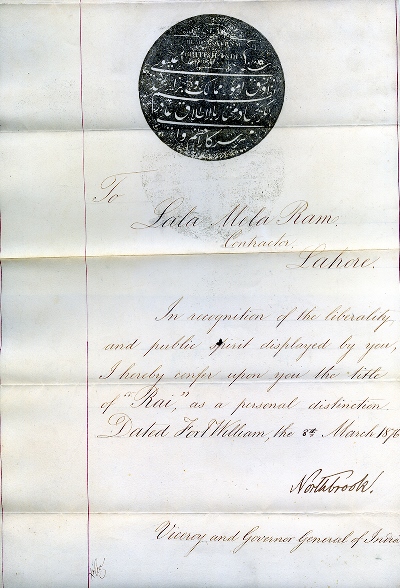
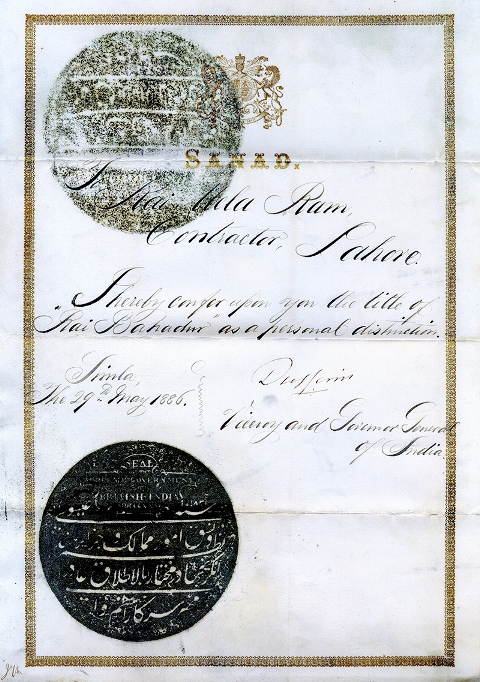
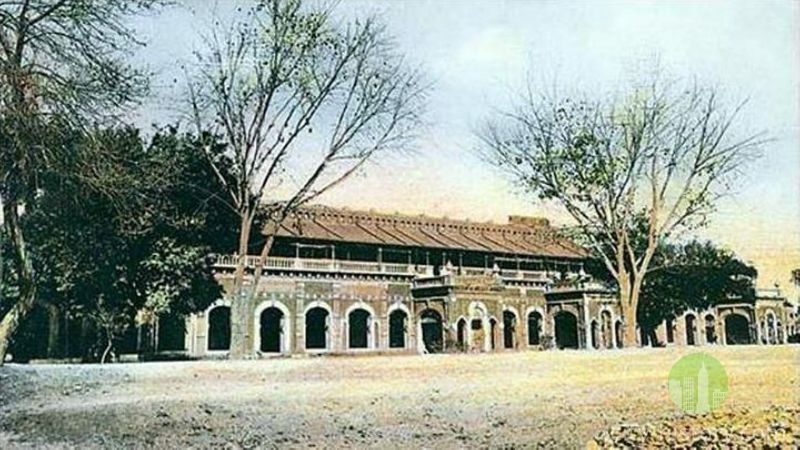
Lala Mela Ram was a famous son of Lahore. His factory, his house as well as his many things were left in Lahore. The Mela Ram road is still there near Data Darbar Sahib and is called Darbar road now. A huge safe was salvaged by people, which included a host of documents. Stocks worth lakhs of rupees, photographs of his family, invitation cards (including the investiture of British Kings and Queens) from London, an astro globe of horoscope, a Kama Sutra manuscript with illustrations, as well as the certificates of his proclamation as RAI and as RAI BAHADUR. Chughtai Museum just acquired these two documents for record archives, at a great cost. The resources did not allow acquisition of other objects.
Lala Mela Ram Lahore Rai Bahadur 1886
The same are presented as a homage of peace from Lahore to the Hindus of India. Live in peace!